.png)
By Dr. Stephanie Brenner
Do you have sesquipedalophobia? Do your students have sesquipedalophobia?
Just now, how did you approach reading the final word in each of the previous sentences?
Did you totally skip it, thinking its meaning and importance would be revealed later? Did you start at the beginning and try each part but did not blend it all together? Did you look for parts you recognized and piece it all together? Or were you fortunate enough to already know the word? No matter your approach, I almost guarantee your students use all of the above strategies at any given time with varied success. It is safe to assume that if highly educated, well-read adults use those strategies, why would we think students are any different? In case you were wondering, the final word of the sentence means “fear of long words” and has eight syllables: ses-qui-pe-da-lo-pho-bi-a.
Everyone Faces Unknown Words
Every reader will eventually come to a word they do not know. Being confronted with an unknown word, especially if it is long, requires effort and resilience. Students (and adults) are less likely to put forth effort to decode an unknown word without a strategy that feels like second nature. Explicitly teaching strategies to break words apart can begin as early as kindergarten when students start reading words with the inflectional ending -s or part of word families (e.g., up, cup, pup, etc.). Strategies for breaking words apart are necessary in first grade when students are introduced to compound words, and according to Kearns & Hiebert, “every fifth or sixth word that first graders encounter is polysyllabic [more than one syllable]” (2021, pg. 16, Shaywitz, 2020). Repetitive practice, with guidance and feedback, of a strategy will increase a reader’s confidence, which is essential by third grade “where every fourth word is morphologically complex [has multiple meaningful parts or syllables]” (Kearns & Hiebert, 2021, p. 16; Shaywitz, 2020).
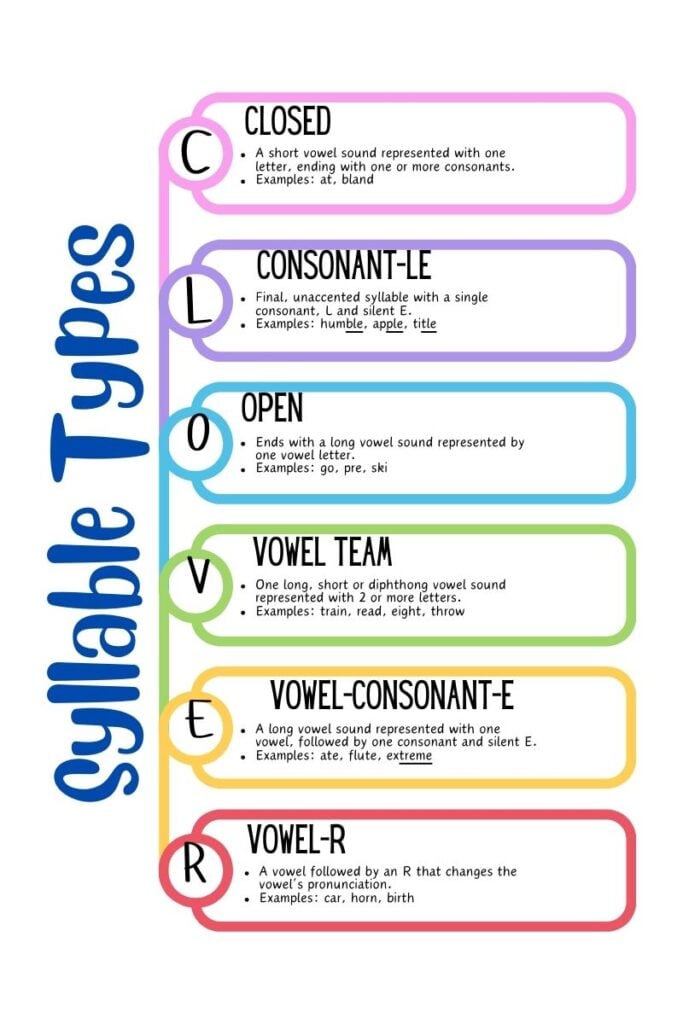
Knowledge of syllable types is fundamental to teaching students to break unknown words into parts for decoding.
Five-Step Strategy for Unknown Words
But it cannot stop there. A simple five-step strategy can be utilized whenever a student encounters an unknown word.
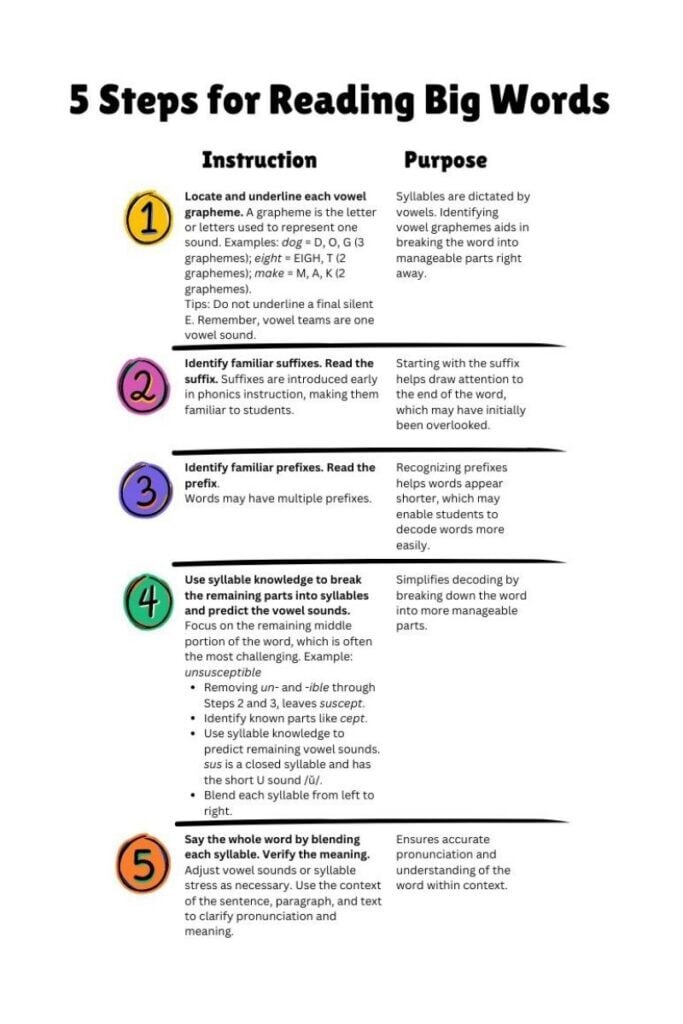
Freezing, appealing, skipping, or random guessing does not need to be the preferred strategy students use when they encounter an unknown word. Explicitly teaching this simple five-step strategy can empower students to read any word, no matter how big its size. Higher levels of comprehension and reading enjoyment will occur when students confidently and accurately read each word.
This five-step strategy does not have to be, and should not be, limited to just the students of those reading this. School and curriculum leaders should consider its consistent implementation across all classrooms and schools for maximum impact and gains in student achievement.
Now, how will you break apart and read hippopotomonstrosesquippedaliophobia? (Hint, there are 14 syllables.)
References
Blevins, W. (2001). Teaching phonics & word study in the intermediate grades. Scholastic Professional Books.
Fisher, D., Frey, N., & Hattie, J. (2016). Visible learning for literacy, grades k-12: Implementing the practices that work best to accelerate student learning. Corwin.
Kearns, D.M. & Hiebert, E.H. (2021). The word complexity of primary-level texts: Differences between first and third grade in widely used curricula. Reading Research Quarterly, 0(0), 1-31. https://doi.org/10.1002/rrq.429
Moats, L.C. (2020). Speech to print: Language essentials for teachers (3rd ed.). Paul H. Brookes Publishing Co.
Shaywitz, S. & Shaywitz, J. (2020). Overcoming dyslexia (2nd ed.). Penguin Random House LLC.