
By Constance Hallemeier Welcome to the second in our three-part series on the Standards for Mathematical Practice (MPs) in the secondary classroom! The MPs are the heartbeat of math instruction; they describe the ways of knowing and habits of mind that we want to cultivate in our students as they grow into mature mathematical thinkers. While the content standards tell us what students need to know, the practices tell us how they should engage with and do mathematics.
Here we continue to explore these practices to help focus our instruction. This series is for secondary educators, and a parallel series for the elementary level is being posted separately to provide a full K-12 perspective. We continue our journey with the Modeling and Data Analysis Standards, MP 2, MP 4, and MP 5.
The Standards for Mathematical Practice (MP) describe the habits of mind that mathematically proficient students exhibit. They emphasize process and expertise, not just content knowledge. Today, we focus on three critical practices that shift mathematics from rote computation to meaningful application and strategic thinking: Reasoning Abstractly and Quantitatively (MP2), Modeling with Mathematics (MP4), and Using Appropriate Tools Strategically (MP5).
Standard 2: The Art of Thinking Conceptually and Mathematically
Reason Abstractly and Quantitatively
So, we made it to the standard for working with numbers. We already do that every day in math when students do word problems, right? Mathematical Practice 2 goes beyond just doing word problems and requires students to make sense of quantities and their relationships in problem situations. This involves two distinct focuses in teaching and learning: decontextualizing (representing a real-world situation symbolically and manipulating those symbols) and contextualizing (pausing during symbolic manipulation to make meaning of the symbols in their original context). Proficient students attend to the meaning of quantities, not just how to compute them.
MP 2 in Action
Students who master reasoning abstractly and quantitatively can:
- make sense of quantities and their relationships.
- decontextualize (represent a situation symbolically and manipulate the symbols) and contextualize (make meaning of the symbols in a problem) quantitative relationships.
- understand the meaning of quantities and are flexible in the use of operations and their properties.
- create a logical representation of the problem.
- attend to the meaning of quantities, not just how to compute them. (2017)
Students who reason abstractly and quantitatively can take complex situations, represent them with equations or functions (decontextualize), solve the symbolic problem, and then look back at the units and context to ensure the solution makes sense (contextualize). They know and flexibly use properties of operations in all functions.
Practical Classroom Strategies
- Contextualize and Decontextualize Problems: Challenge students to create an algebraic model from a real-world problem (decontextualization). Conversely, give students a purely abstract equation (like 2x+5=17) and ask them to create a story or real-world situation that it could model (contextualization).
- Emphasize Units and Meaning: Require students to include units with all quantities and use dimensional analysis. In an equation like y=3x-4, consistently ask: “What does the 3 mean in the context? What does the -4 mean?”.
- Require Interpretation of Solutions: After solving, demand that students write a complete sentence interpreting the mathematical solution within the context of the original problem. This includes checking reasonableness; for example, if the solution for “number of people” is x=12.3, they must reason that the practical answer is 12. (2012)

Standard 4: The Art of Problem Solving
Model with Mathematics
Draw a picture, draw a picture, draw a picture. That’s all this standard is about, right? Mathematical Practice 4 is the ability to apply the mathematics students know to solve problems arising in everyday life, society, and the workplace. Modeling involves simplifying a complex problem, identifying important quantities, representing relationships using mathematical tools (equations, diagrams, graphs), interpreting the results, and reflecting on the model’s appropriateness. So, it’s more than drawing pictures, so much more.
MP 4 in Action
Students who master modeling with mathematics can:
- understand this is a way to reason quantitatively and abstractly (able to decontextualize and contextualize).
- apply the math they know to solve problems in everyday life.
- simplify a complex problem and identify important quantities to look at relationships.
- represent mathematics to describe a situation either with an equation or a diagram, and interpret the results of a mathematical situation.
- reflect on whether the results make sense, possibly improving/revising the model.
- ask themselves, “How can I represent this mathematically?” (2017)
Secondary students are comfortable making assumptions and approximations to simplify complex situations. They can identify important quantities (like rates of change) and map relationships using diagrams, tables, graphs, and formulas. Crucially, they routinely interpret their mathematical results back into the context and reflect on whether the results make sense, potentially revising the model.
Practical Classroom Strategies
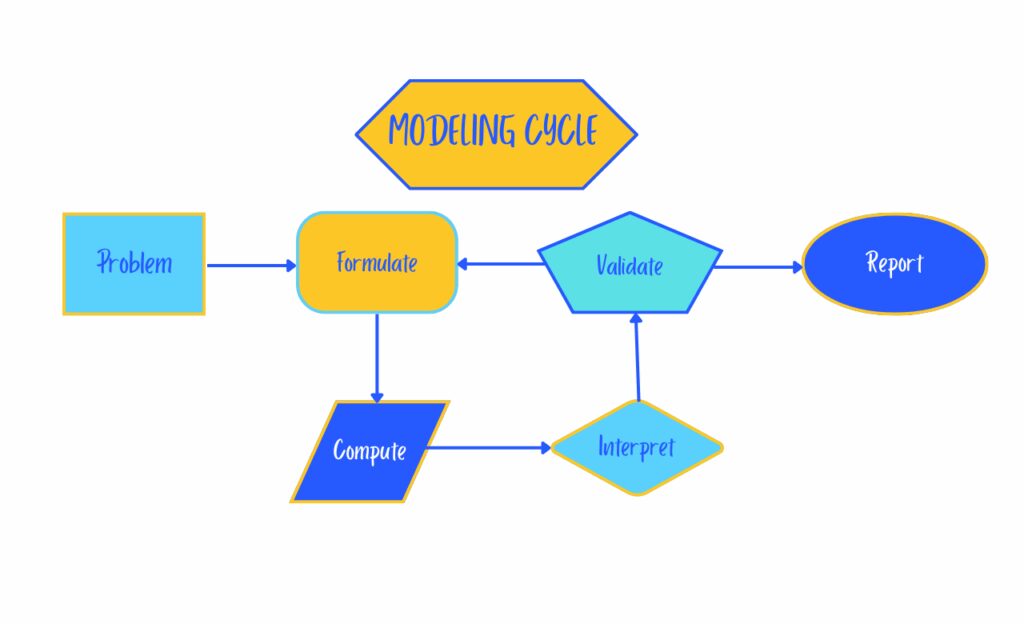
- Teach the Modeling Cycle: Guide students through the systematic process: Formulate (identifying variables and assumptions), Compute (solving the math), Interpret (relating results to context, focusing on units), and Validate (checking reasonableness).
- Use Authentic, Open-Ended Problems: Move past simple textbook problems. Use real-world data problems (e.g., “How many gallons of paint are needed to paint all the classrooms?”) that require students to define parameters and make assumptions actively.
- Require Model Documentation: For complex tasks, require students to clearly state the problem, all assumptions made, the specific mathematical model(s) used, and the final contextual interpretation.
- Model Critique: Have students compare and critique two or three different mathematical models for the same problem, discussing which one is more realistic given the constraints. (2012)
Standard 5: The Art of Choosing Wisely
Use Appropriate Tools Strategically
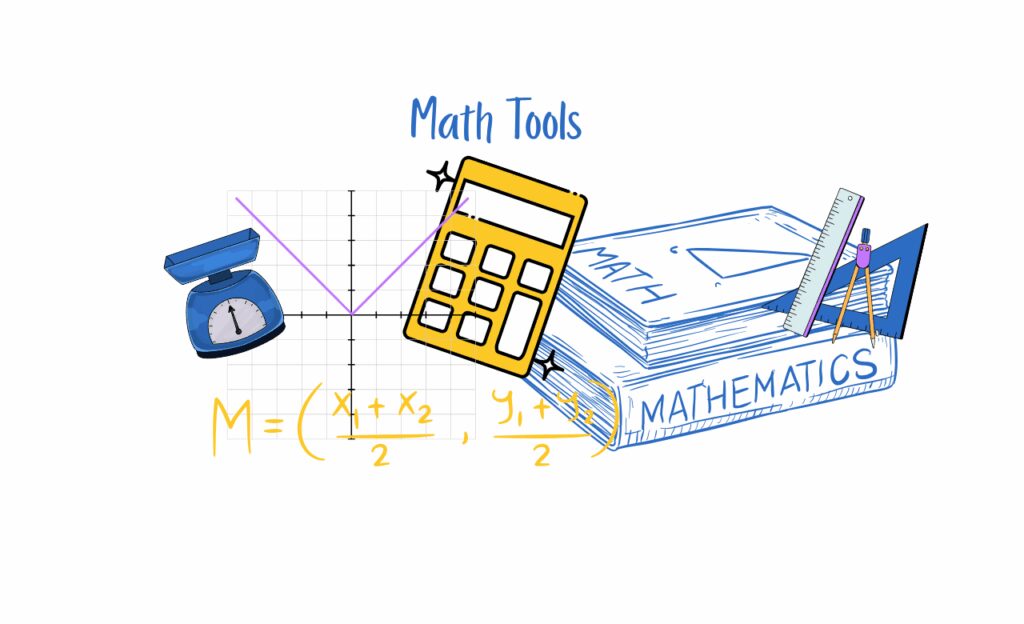
We need to buy more things to implement this standard, right? NO we don’t need to buy a bunch of things – it is about looking at what is in front of you and choosing the best tool, method, or approach when solving a problem. Tools are broadly defined, including physical objects (manipulatives, rulers), representational tools (diagrams, graphs, estimation), conceptual tools (algorithms, formulas), and technology (calculators, spreadsheets, dynamic software). Proficient students recognize both the insights to be gained and the limitations of each tool.
MP 5 in Action
Students who master using appropriate tools strategically can:.
- use available tools, and recognize the strengths and limitations of each.
- use estimation and other mathematical knowledge to detect possible errors.
- identify relevant external mathematical resources to pose and solve problems.
- use technological tools to deepen their understanding of mathematics.
- use mathematical models to visualize and analyze information. (“Massachusetts Mathematics Curriculum Framework — 2017”)
Secondary students strategically use estimation to check the reasonableness of solutions. They use technology like graphing calculators to model functions or dynamic geometry software to discover properties. They can detect potential errors by strategically applying estimation and other mathematical methods. They understand that some tools (like drawing a graph by hand) might be inefficient for complex calculations.
Practical Classroom Strategies
- Explicit Tool Modeling: Teachers should demonstrate and provide experiences with various tools. When solving problems, teachers should use Think-Aloud Modeling to narrate the decision-making process: explaining why they chose a particular formula (conceptual tool) over a graphing calculator (technology tool).
- The “Tool Showdown”: Present the same problem and task groups with solving it using different tools (e.g., algebraic substitution vs. graphing calculator vs. table of values). Then discuss which method was most efficient and why.
- “Justify Your Tool” Requirement: Integrate tool selection into assessments by requiring students to write a brief justification for their choice of a specific formula, algorithm, or piece of technology.
- Ensure Accessibility: A variety of tools should be within the environment and readily available to students. (2012)
Building Modeling and Data Analysis Together
For these standards to be truly implemented, the entire educational system must align planning, delivery, and professional development around the core ideas of the practices.
Teachers, Instructional Coaches, Administrator Questions to Guide Implementation
MP 2 Questions
How are we consistently requiring students to move back and forth between the abstract mathematical representation (the equation, function, or graph) and the real-world context, including a written interpretation of the solution?
MP 4 Questions
How are we ensuring a regular sequence of authentic, open-ended modeling problems that require students to document their assumptions and approximations, not just solve for a single numerical answer?
MP 5 Questions
What opportunities are we creating for students to independently choose among multiple available tools (e.g., technology, manipulatives, conceptual formulas) and articulate why their chosen tool was the most efficient or appropriate for the task?
Secondary math teachers can build on the strategies mentioned in the Elementary article about modeling and data analysis in the math classroom to help students continue to grow as mathematicians. Mastering modeling and data analysis standards sets students up to be better consumers of mathematical knowledge in the real world. When we prioritize “Reasoning Abstractly and Quantitatively”, students will connect symbolic representations to their quantitative meanings and flexibly move between concrete examples and abstract math. When we prioritize “Modeling with Mathematics”, students will learn to judge whether their results make sense in the context of the problem and understand the limitations of their mathematical models. And when we prioritize “Using Appropriate Tools Strategically,” students will develop a strategic competence in mathematics that allows them to make sound decisions about when to use technology, mental math, or standard algorithms.
How will you adjust your lesson plans this week to prioritize modeling and data analysis in your classroom?
Our first post on mathematical practices explored Communication (MPs 3 and 6). Follow us for our final part in this series, where we will discuss Problem Solving (MPs 1, 7, and 8).
References
- Implementing standards for mathematical practices. Achieve The Core. (2012, May). https://achievethecore.org/peersandpedagogy/wp-content/uploads/2016/06/Implementing-Standards-for-Mathematical-Practices-Updated-2016.pdf
- Massachusetts Mathematics Curriculum Framework — 2017. Massachusetts Department of Elementary and Secondary Education. (2017). https://www.doe.mass.edu/frameworks/math/2017-06.pdf
- Mathematical practice standards: Inside mathematics. The University of Texas Dana Center. (n.d.). https://www.insidemathematics.org/common-core-resources/mathematical-practice-standards
- National Governors Association Center for Best Practices and Council of Chief State School Officers. (2010). Standards for mathematical practice | common core state standards initiative. https://www.thecorestandards.org/Math/Practice/