
By Constance Hallemeier
For years, traditional family engagement has relied on a passive model: parents attend an annual Open House, listen to short presentations, and wait for quarterly report cards. Although these practices provide important information, they do not always build the ongoing, two-way relationships that allow educators and families to work together to support student learning and well-being. The family-school connection should be one of the most valuable connections for supporting student learning and attendance. The open house provides an overview of the year, but nothing to connect families to the classroom; weekly emails rarely provide families the detailed information they need to support learning, online grade checks do not provide families with key insights about student struggles or extensions, and attendance reports don’t provide families with why students don’t want to attend school. But how much is too much, and who should be providing the information: teachers, counselors, administrators?
To cultivate environments where every student thrives, schools must pivot from transactional updates toward authentic, relational collaboration. Drawing on insights from research published in Educational Leadership (ASCD), this guide explores how educators and administrators can build meaningful, equity-focused partnerships with families.
Strategic Classroom Communication
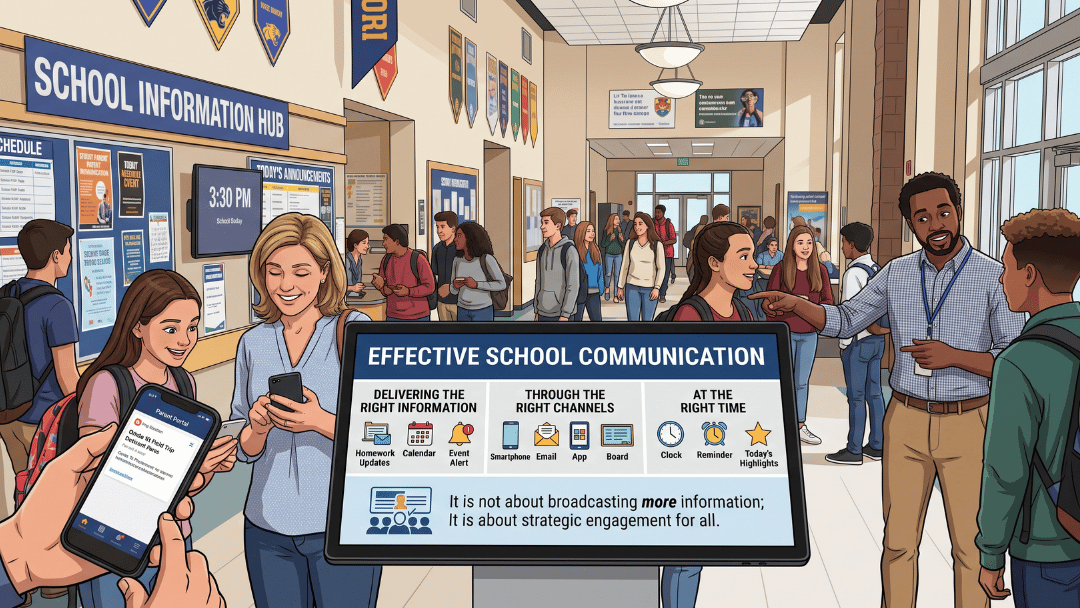
Effective communication is not about broadcasting more information; it is about delivering the right information through the right channels at the right time. It’s finding the sweet spot of communication and fostering partnerships with families.
Finding the Sweet Spot
Rather than contacting families only when a student struggles, proactive outreach establishes trust before issues arise. When I first began teaching, I had students create collage postcards that I sent home when I noticed a celebration for a student. After snail mail became a thing of the past, I made an effort to phone every family to share a celebration, and when email became the best form of communication, I made an effort to email families to share a celebration. These were easy and effective ways to start a collaboration with families.
If I began to see a student struggle, I had a relationship with a family and could contact them for assistance. These early interactions also helped me to be able to contact families to:
- Honor Family Expertise: I could contact home not as an expert delivering a lecture, but as a listener seeking advice. Asking parents simple questions like "What motivates your child at home?" or "What makes them happiest?" validates their deep knowledge of their children.
- Cultivate Cultural Awareness: I got a better understanding of their students' cultural backgrounds and family dynamics. This gave me insight into how those differences may be seen in the classroom.
- Promote Measurable Results: By partnering with families, we can discuss solutions and to encourage students to attend school and make an effort. We can build a plan together to help students continually show growth in the classroom.
The sweet spot refers to communicating with families without overwhelming them with too much communication - some families have students at elementary, middle, and high school with multiple teachers and subjects. So, if an elementary teacher provides weekly emails to families about the classroom happenings, a set of middle school team provides emails to families on a weekly or monthly basis, and a set of high school teachers provides emails to families on a weekly or monthly basis, then one family could be receiving upwards of a dozen emails a week. Be cognizant of this communication overload. If there is an urgent or critical issue, contact the parent via phone call instead of email.
Habits to Foster Partnerships
Families need to be partners in education and this involves habits to help those relationships grow.
- Habit 1: Make relationships a top priority: Cultivating the essential partnerships your students require demands that you treat relationships as a foundational priority. Dedicate time to being fully present during interactions, remain accessible to families, and practice patient, attentive listening.
- Habit 2: Assume best intentions: Families are sending the best version of their child(ren) to school. When communicating with them, it is essential to validate this and acknowledge that they are striving to do their best.
- Habit 3: Share stories: Create opportunities within the school community for families to share personal experiences that build meaningful connections, mutual understanding, and deeper relationships. Refrain from assuming another person's story reflects your own or that they interpret their life experiences as you would.
- Habit 4: Engage in conflict constructively: Rather than avoiding conflict, which can undermine relationships, actively addressing and navigating disagreements builds stronger bonds and enhances collaboration. Seek to understand the core differences and work toward solutions that benefit everyone.
- Habit 5: Strive for hope-filled interactions: Focus on student strengths and share the assets they bring to their education. Acknowledge what families provide for their child(ren)’s education and seek to develop a realistic understanding of what families may need.
Reframing the Narrative: Shifting Focus from Grades to Learning
One type of communication focuses on a student’s performance in class, centered on grades. When communication centers solely on letter grades, families receive feedback that isn’t actionable. To cultivate strategic, self-directed learners, teachers must invite families into the feedback loop and focus on learning, rather than a score.
The Limits of Evaluative Feedback
Online gradebooks make it easy to see percentages daily, but a letter grade tells a caregiver very little about how a student is learning or what steps they should take next to support learning. To grow, students need descriptive feedback that is actionable, clear, and focused on learning processes.
The 4-Step At-Home Discussion Protocol
Instead of sending home a graded paper with just a letter grade at the top, consider sending home work with a rubric, an example, and a structured discussion guide for families/caregivers to use to talk with their student.
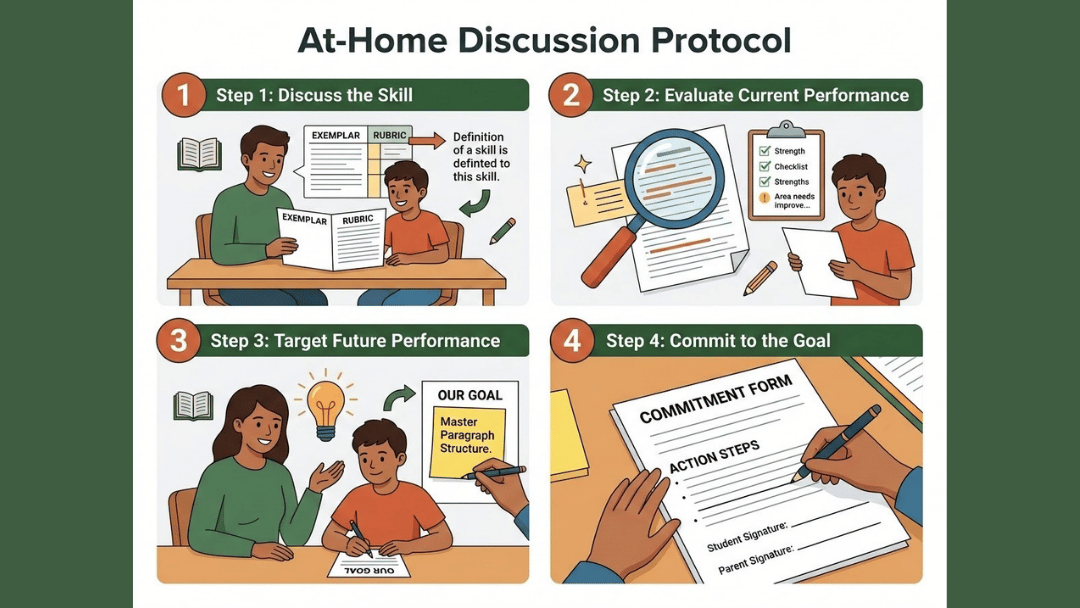
This routine breaks down academic standards for families, reduces anxiety around report card season, and turns the home into a supportive extension of the classroom. If this seems overwhelming, consider doing this once a unit/month or only for mastery of priority standards. Providing the exemplar or scoring guide on a classroom learning management system that parents can access can also alleviate stress for families.
Administrative Leadership: Listening and Gathering Authentic Input
Teachers provide the day-to-day communication with families, but school leaders set the tone for how families are received throughout the year and how their input is used to support the school. True partnership requires administrators to create spaces where families are actively heard. Identifying different partnership models that may strengthen school-family communication is essential to building the bridge.
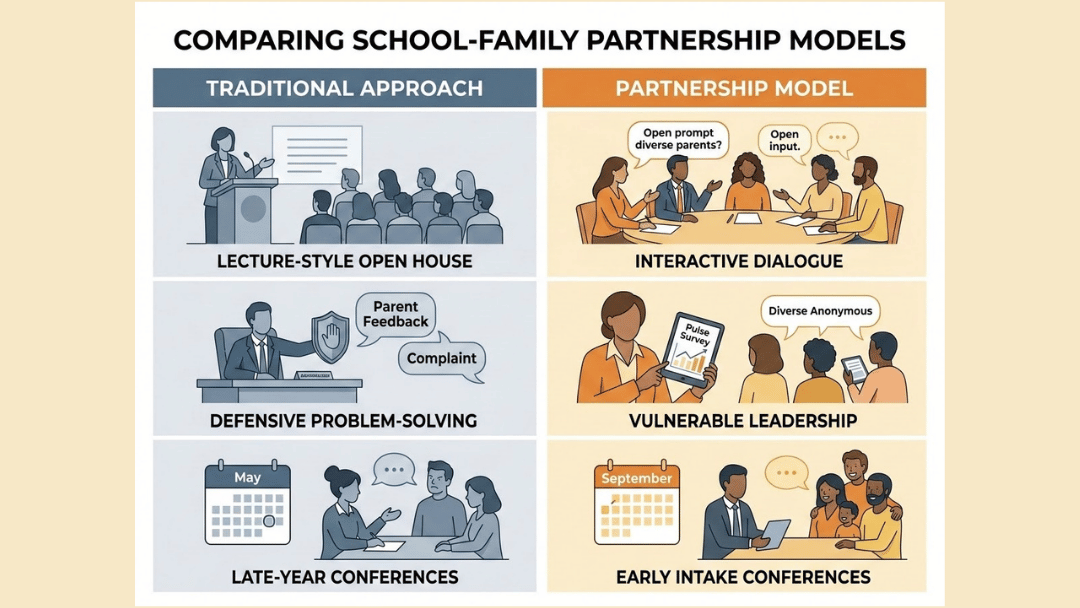
Administrative Strategies:
- The Family Questions: As families enter Open House, hand them an index card and ask to share their answers to: "What is the main thing you want our school to foster in your child this year?" Sharing these insights with faculty helps align school climate goals with family priorities.
- Intake Conferences: Hold family meetings or shadowing days during the first month of school. Focus the conversation around open-ended questions like: "How does your child handle frustration?" or "What are your personal goals for your student this year?" One school I worked with offered parents the opportunity to shadow a school day and share their insights at the end. The outcome was open communication with families about what they saw and ideas for improvement.
- Continuous Feedback Loops: Run brief, regular surveys throughout the school year following major events (conferences, Open House, mid-year check-ins). Use parent responses to reflect on perceptions and refine institutional practices. If your parents suffer from survey fatigue, use the results you have to make informed decisions and connect those decisions to the results.
Creating True Partnerships
Building authentic partnerships with families requires schools to break down barriers created by differences. When families don’t feel part of the school community's culture, they won't receive communication as informative or useful. Educational leaders, as well as teachers, can utilize certain shifts to help build that school community.
Essential Shifts:
- Ensure Language Access: Multilingual communication is an easy modification for equity. Using translation tools for emails, newsletters, and phone calls ensures every family has direct access to school information.
- Adopt an Asset-Based Lens: Step away from language that highlights student deficits. Recognize that every family possesses deep cultural wealth, community wisdom, and a desire to see their children succeed.
- Broaden the Definition of "Involvement": Presence in the school building is not the only indicator of a dedicated parent. Reading together at home, discussing school experiences, and encouraging resilience are powerful forms of engagement that must be recognized and valued. Provide families with suggestions for involvement at home; many resources have these readily available.
- Co-Create Solutions: Transition from deciding for families to planning with them. Consult families when drafting school policies, adjusting schedules, or launching new academic programs. And when a student is struggling academically or behaviorally, enlist families to help develop an implementation plan.
Moving Forward
Building true school-family partnerships is an ongoing commitment to empathy, clear communication, and shared responsibility. By replacing outdated involvement models with proactive outreach, descriptive feedback, and inclusive leadership, schools can build a foundation where families and educators work as allies.
Next Steps for Educators:
- Try initiating one proactive, positive contact with a family this week.
- Review your next family communication to ensure it focuses on learning growth rather than just grades or logistics.
- Audit your school's communication tools to ensure full language accessibility for every family you serve.
Next Steps for Administrators:
- Try auditing family communication channels to ensure all the messages are in families' home languages and balanced between logistics and academic growth.
- Transform an upcoming family event to incorporate dialogue and listening strategies to gather family goals for the school and their children.
- Establish ongoing feedback channels to gather authentic family perspectives, address evolving insights, and model transparent leadership.
References
Barnwell, Paul. “Engaging High School Parents.” Educational Leadership, vol. 60, no. 2, 2018. ASCD.org, https://www.ascd.org/el/articles/engaging-high-school-parents.
Hoerr, Thomas R. “Principal Connection/What Are Parents Thinking?” Educational Leadership, vol. 69, no. 4, 2011. ASCD.org, https://ascd.org/el/articles/what-are-parents-thinking.
Kraft, Matthew. “Engaging Parents Through Better Communication Systems.” Educational Leadership, vol. 75, no. 1, 2017. ASCD.org, https://www.ascd.org/el/articles/engaging-parents-through-better-communication-systems.
Radd, Sharon, et al. “What If Schools Truly Partnered with Families Living in Poverty?” Educational Leadership, vol. 80, no. 4, 2022. ASCD.org, https://ascd.org/el/articles/what-if-schools-truly-partnered.
“Working with Parents to Take the Focus Off Grades.” Educational Leadership, vol. 10, no. 24, 2015. ASCD.org, https://ascd.org/el/articles/working-with-parents-to-take-the-focus-off-grades.