By Dr. Natalie Fallert
Welcome back to my second installment on the Science of Reading from a secondary lens. I’m starting with the word recognition strand of Scarborough’s Reading Rope, where phonological awareness and phonics live.
Before we go any further, a reminder: the Science of Reading is grounded in decades of research about how the brain works—how it learns, processes, and applies knowledge. As you read, keep asking yourself how this strand fits into the brain’s workload during reading.
A Quick (Honest) Disclaimer
For the record, this strand is mostly elementary. What I can offer is an understanding of how this strand shows up in secondary classrooms, why gaps here matter, and how it connects to the bigger phonics beast we’ll end with: orthographic mapping.
Because even though phonics mostly lives in elementary classrooms, gaps in this strand show up loudly in secondary ones.
Let’s Get Started
Most secondary students can decode; they can sound words out, but many lack automaticity and efficiency. When a student truly cannot decode, that typically requires targeted intervention beyond core instruction. While the bulk of decoding instruction occurs in earlier grades, there are important ways secondary teachers can support students.
Once we establish that students can read the words, they usually fall into one of three big-picture categories:
- They read and are doing relatively fine.
- They are slow, laborious, chunky readers.
- They sound smooth, but cannot tell you what they just read.
Understanding how students got here requires a quick drive-through of phonological awareness and phonics development.
The Big Idea First: Humans Were Not Built to Read
Humans were not made to read and write. Reading is new in human evolution.
We are biologically predisposed to speaking and listening. Babies do not need explicit instruction to learn to talk—if they are spoken to, they mimic sounds and attach meaning naturally, even if they never see a word in print.
Reading, on the other hand, must be taught.
Birth–Pre-K
Children begin to understand the alphabetic principle—that there is a systematic relationship between letters and sounds.
A classic example: a three-year-old sees the golden arches and shouts, “McDonald’s.” They cannot read, but they understand that visual symbols (including letters) carry meaning and represent sounds or words.
Kindergarten–2nd Grade
Through explicit and systematic instruction, children learn to decode. They map sounds to letters: when they see b, they know it says /b/.
There is a very intentional sequence to this instruction. Certain sounds are taught before others based on the frequency of use and level of complexity. For example, students typically learn t before blending th.
If you want to go deeper here, I highly recommend checking out my colleague Dr. Brenner’s work. She is a full-on phonics fanatic—in the best way.
When this instruction is done well, by the end of second grade, most students have a strong foundation in letter–sound associations and can blend most common sound patterns. This takes years because instruction is slow, deliberate, and packed with repeated practice to move learning into long-term memory.
3rd–4th Grade
At this point, students should reach Ehri’s full alphabetic phase. They can fully decode, segment, and blend sounds across whole words.
What does this look like?
When students see a word like school, they read it automatically and know what it means—this is rapid word recognition. Because students have been taught letter–sound patterns and blending rules and have repeatedly been exposed to high-frequency words, these words are stored in long-term memory for quick retrieval.
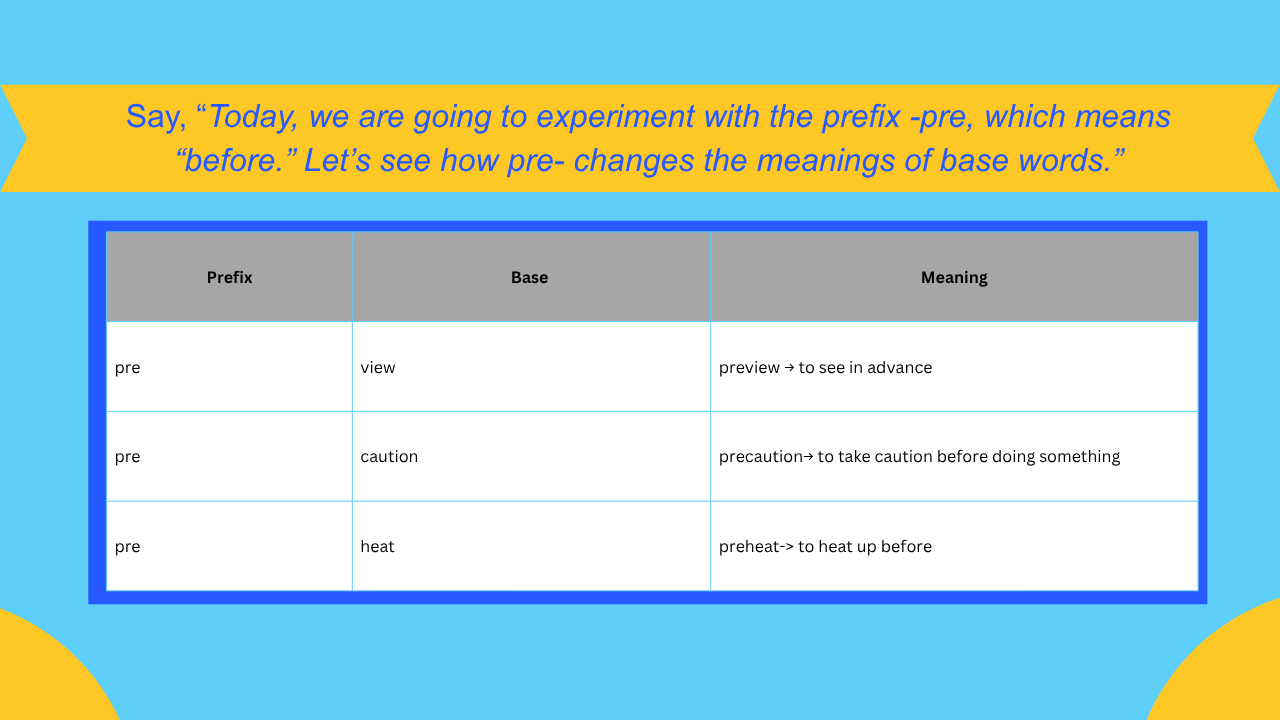
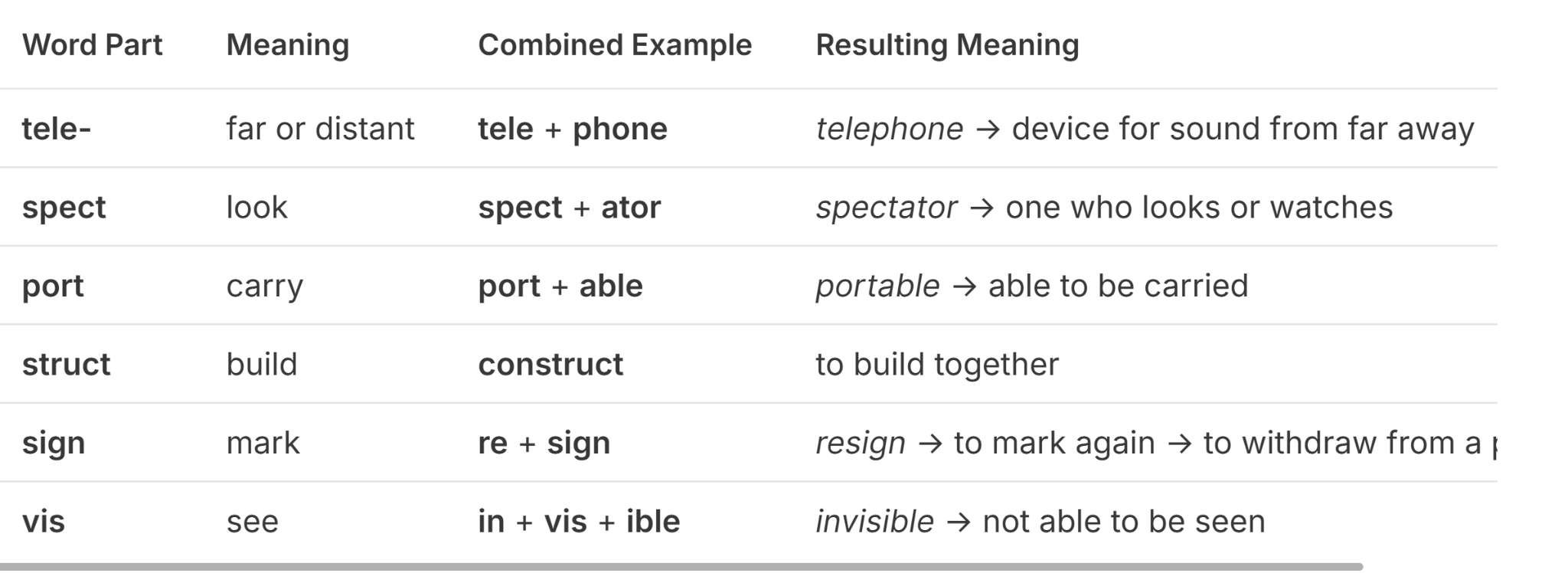
Phonics instruction doesn’t disappear here—it becomes more complex. This is where many schools shift into word study or morphology: the study of meaningful units of language, including word origin, function, and how parts combine.
Examples:
- jump + -ing → jumping
- More complex suffixes like -sion, -able, -ible
5th–7th Grade
This is the true shift from learning to read to reading to learn.
Traditional reading instruction fades into the background as teachers focus on content. Students have reached the consolidated alphabetic phase, meaning they automatically recognize common morphemes and larger word units.
Because they no longer need to labor over decoding, their cognitive resources are freed up for comprehension, which is the desired outcome of reading.
7th Grade and Beyond
By this stage, students should have a well-developed orthographic lexicon—an extensive mental dictionary of words they can read on sight and connect to the meaning with minimal effort.
When this system is weak, comprehension collapses, even if students appear fluent.
A Walk in Their Shoes
Let’s make this concrete.
Read this word:
umbrella
You read it quickly and effortlessly.
Now try this:
physiology
You probably hesitated. Maybe you initially leaned toward psychology or physical. Still, you were able to read it, and once you did, you likely had a rough sense of its meaning.
Now try this:
bienvenida
(Spanish speakers—you get a pass.)
Everyone else likely stopped, sounded it out, maybe broke it apart. You might recognize bien as something positive or meaning “well,” but most of you could pronounce the word without being able to explain it.
You can say it—but you can’t comprehend it. Why? Because you lack the knowledge needed to know that bien (well) and venida (come) together mean welcome in Spanish.
This is exactly what many secondary students experience every day.
Why This Matters in Secondary Classrooms
If your school uses a diagnostic like iReady or STAR, you may notice a familiar pattern: students cluster around grade level—or stall around fifth grade. This progression helps explain why.
There are countless reasons students may not move smoothly through these stages—and you can’t fix the past. What you can do is support the students sitting in front of you.
What Might Be Missing—and What Helps
Missing word study?
- Explicit instruction in root words and affixes
Missing automaticity?
- Choral reading with eyes on print
Missing volume reading?
- Wide reading exposure across texts and genres
You might notice:
- Students who need more complex morphology work.
- Students who need repeated oral reading to strengthen rapid recognition.
- Students who simply need more text to build an extensive mental dictionary.
- Students who need extended time to complete assignments.
Small, Practical Steps
- Give students a quick morphology survey to identify gaps.
- Work with grade-level and vertical teams to create a progressive list of roots and affixes to explicitly teach.
- When tackling a complex text:
- Call out tricky words
- Say them aloud
- Have students repeat them
- Define them together
- Annotate meanings directly in the text
Bringing It Back to Orthographic Mapping
All of these experiences—phonics, morphology, repetition, and exposure—feed into orthographic mapping: the process that makes words instantly recognizable and meaningful. Dian Prestwick says, “It’s the brain wiring sounds to print so words become permanently stored and easily retrieved again and again.”
As we explore more components of the Science of Reading, it will be easier to see the interconnectedness of each strand and gain more strategies to help students in your classroom. Stay with me as I dig into different literacy components: Oral Language & Fluency, Vocabulary & Background Knowledge, and Print Awareness & Comprehension.
Resources
Iowa Department of Education. (2025). Iowa comprehensive state literacy plan (2024–2032). Iowa Department of Education.
Scarborough, H. S. (2001). Connecting early language and literacy to later reading (dis)abilities. In S. B. Neuman & D. K. Dickinson (Eds.), Handbook of early literacy research (pp. 97–110). Guilford Press.
Ehri, L. C. (2014). Orthographic mapping in the acquisition of sight word reading, spelling memory, and vocabulary learning. Scientific Studies of Reading, 18(1), 5–21. https://doi.org/10.1080/10888438.2013.819356
National Institute of Child Health and Human Development. (2000). Report of the National Reading Panel: Teaching children to read. U.S. Government Printing Office.