By Dr. Natalie Fallert
I didn’t think the Science of Reading had anything to do with me. I was wrong. This blog is for my secondary friends (teachers, administrators, and coordinators)–the ones who hear “Science of Reading” and immediately think “elementary”. That was me.
I have recently begun my painstaking journey to learn about and understand the Science of Reading and how it impacts me as a secondary educator. So let's go back in time.
Why I Tuned It Out
I work with Compass PD, and our founder, Dr. Carrie Hepburn, has been talking with us for a while now about the Science of Reading, its implications on education, and its impact on many of the school districts we work with. I’ll be honest: when I first heard “Science of Reading,” I tuned out. I assumed it was an elementary thing—phonics, decoding, little kids sounding out words. Not my lane. (Sorry, Carrie)
Now, I share this because I was recently working with 9-12 ELA teachers and asked them what they know about the Science of Reading. The overwhelming consensus was “nothing” or that they “hadn’t even heard of it”. I know their content supervisor has presented this information to them as part of their state initiative (which isn’t Iowa). She was shocked at their response. I was not surprised because I too did the same thing with my boss.
The Wake-Up Call
In the summer of 2025, Carrie asked us all to do a book study. I use this term very lightly because we didn't get to just read a great new book or an actually interesting professional book; we got to read the entire Iowa Comprehensive State Literacy Plan which is a 234-page document outlining Iowa’s plan and an in-depth look at their “strategic, evidence-based approach to achieving literacy proficiency for all students, birth through grade 12”.
Because I am a rule follower, pleaser, and overall decent coworker, I begrudgingly complied and began reading, with the idea that I might have to step in and help out the elementary folks if needed. I figured I might be a last-ditch PD resort for the Science of Reading and the literacy plan for elementary teachers, so I will need to learn more about it. Boy, was I wrong!
Once I started reading this comprehensive plan, my mind was whirling with questions about the implications of the Science of Reading in the secondary classroom. Yes, the Science of Reading focuses largely on elementary practices, but that doesn't mean secondary educators aren’t seeing struggling readers in their classrooms every day. Struggling readers who are falling further and further behind, and seeing an increasing number of struggling readers.
- There are a ton of instructional practices, strategies, and professional learning opportunities for elementary teachers to help their students become strong, effective readers, but what about kids in 6th through 12th grade who didn't get all those science-based practices? Kids who are currently sitting in our classrooms. Kids who missed part of that instruction somewhere along the line.
- How do secondary educators help these students become stronger, more efficient, independent readers?
I am not suggesting that any of my secondary friends read the Iowa Comprehensive State Literacy Plan; nobody has time for that. However, I can ask you to go on this journey with me, as I share my questions and report my findings through a secondary lens. Also, this is not just a blog for Iowa teachers. This is for ALL secondary teachers/administrators/coordinators regardless of location or subject area.
Disclaimer
This series is not about expertise–it’s about inquiry, reflection, and professional curiosity. I have recently (June 2025) started my learning journey in SOR, and I am finding that there is very little research or information on SOR and secondary classrooms. This series is an opportunity for me to share my reading and research, mixed with my classroom experience, to lay enough of a foundation to spark a fire or initiate a hankering in my peers to put this on their radar. If you see words, ideas, concepts, etc. that are unfamiliar, I promise, they were to me as well! Don’t fret and don’t worry about trying to figure it all out right now. I will break them down and explain them at the right time. My initial spark of interest came from reading Iowa’s plan, so here I will outline what got my wheels turning from this document.
Quick Overview of What Really Matters to Me (secondary teacher) of the Iowa Plan
- Introduce the Science of Reading, give an explanation, and break down Scarborough's Rope.
- List Iowa’s Core Literacy Components and explain each one of the components.
- Note: If you Google “Core Literacy Components”, you will not find one specific answer. However, since I was studying Iowa’s plan, I am going to stick with their definition, which includes 8 components: Oral Language, Print Awareness, Phonological and Phonemic Awareness, Phonics, Fluency, Vocabulary, and Comprehension.
- Breakdown of the progressions within each component. Essentially, this is what science suggests kids should be able to do at various developmental stages for each component. The progressions are broken into ages birth-3, 3-5, 5-7, 7-9, 9-12, and 12+.
- As I read through each one of these, I could see former students and students in classrooms I work with daily not meeting these scientifically backed developmental milestones. So the science says they should be able to do this, but the reality is they're not, so now what?
- Introduces the Writing Rope and Stages of Writing Development.
- Offers standards, evidence-based practices, and resources for reading, writing, and content-specific areas.
- However, I was left with more questions in this section than were answered. There were great ideas for birth-elementary. There weren't many actionable items for the 6-12 teacher, which led me to do more research and digging.
My Secondary View of Science of Reading
When I first heard this term, I thought it was coined by one person and reflected their ideas/understandings. Comparable to our education training that taught about John Dewey or Jean Piaget’s contributions to education. Wrong! This is a “vast body of research from multiple fields…and multiple studies that explain how individuals learn to read and the practices most effective in maximizing student literacy outcomes” (2025).
It is not
- one philosophy or even a philosophy
- a specific program
- a single method or approach to teaching
How it differs from what we know, think we know, or were taught
In most teaching programs, pre-service teachers are taught using educational research, which includes pedagogy (instructional methods and instructional materials). This tells us what knowledge a teacher needs and what student outcomes should be expected. You may have also stuck your toe into psychology (developmental and cognitive) research, which includes the study of thinking and learning (memory, attention, perception, problem solving). Essentially, psychological research examines how people learn. Another aspect that needs to be considered is linguistics research: the study of language and its structure (semantics, syntax, morphology, phonetics, etc). Linguistics research informs what we need to teach and the sequence of that instruction. Finally, neuroscience, which is the study of the structure and function of the brain, needs to be considered. Learning how the brain works, specifically in skilled and unskilled readers, provides a better understanding of why we do things in reading. All four of these pieces come together to create the ideas behind the Science of Reading (Lane, 2021).
It is important to understand that the fourth piece, neuroscience, is fairly new. Due to technological advances in neuroimaging, researchers have identified specific brain regions activated during reading. A concept that will continue to be refined as technology advances. I mention this to relieve some of the pressure on all my seasoned teachers. We approached teaching based on our learning, but since our collegiate days, more information has come to light, and it is important for us to acknowledge and learn from it. I am confident that as you continue to read, you too will have “A ha” moments where you see your students in each component and ways that these four aspects of research help explain and offer suggestions for intervention.
My Secondary Understanding of Scarborough’s Rope
Dr. Hollis Scarborough, psychologist and literacy expert, developed a visual model to explain the complexity of reading comprehension. Her model shows that there are two ropes (language comprehension rope and word recognition rope) that are woven together to create a skilled reading rope. The two individual ropes are comprised of individual strands.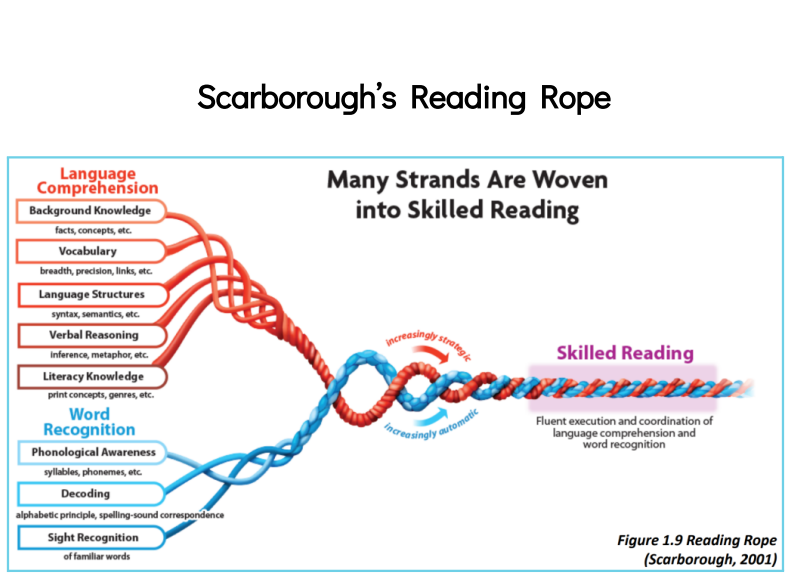
When I look at these two ropes, I am not saying that Word Recognition is not important, but it is not where most secondary educators will spend their time. I will discuss what Word Recognition looks like in a secondary setting in another issue, but most of our time is spent in Language Comprehension. There are many images of her rope, but I particularly like images like this from LETRS because it gives a brief example of each piece and adds the “increasingly strategic” and “increasingly automatic” pieces as the two ropes come together. This is where secondary takes flight! Each of these individual strands is prevalent and important, but a secondary teacher needs to be thinking about how they become increasingly strategic or automatic, and what role you play in ensuring they do just that.
What Comes Next
If you’re a secondary educator who has ever said, ‘This isn’t my job,’ I invite you to stay. Learn with me. Question with me. And rethink what literacy responsibility looks like in 6–12 classrooms. Join me as I tackle various components of this educational shift and how they impact secondary educators. My hope is that you will gain a better understanding of your role in a student’s reading and writing success. I hope to give you a better understanding of how Scarborough’s Rope interacts with different literacy components, as well as ways and resources to consider for fostering these in your classrooms or with your teachers.
References:
Iowa Department of Education. (2025, May). Iowa Comprehensive State Literacy Plan 2024-2032. Des Moines.
Lane, H. B. (2021, January 10). What is the Science of Reading? YouTube. https://youtu.be/cnkJ6VvDr2M