By Dr. Sherri Lorton
You're sitting with a small group, and something just clicked for a kid who's been stuck for weeks. You notice it. You almost always notice it, and teachers do this constantly, without even trying.
Then the moment passes, the day moves on, and by Friday you couldn't tell what exactly changed or why.
That's the real cost of skipping documentation. It’s not that you're not paying attention. You are. It's that the noticing has nowhere to go. And if the last piece in this series was about shifting from general reteaching to specific responsive instruction, from grading to student learning, this is the part that is not always obvious: none of that works without a way to capture what you see.
This is where a simple documentation framework earns its keep. Not another form. Not one more thing to manage. Just a way to catch what you already notice, before it slips past you.
Noticing vs. Using Documentation
Walk into almost any classroom, and you'll find a teacher who's noticing all the time. The student who comes alive during partner talk but goes quiet the second it's time to write alone. The small group that finally gets it, after weeks of “almost there.” Teachers see this stuff. It's part of the job.
The tough part is what happens next. A moment like that can live in your head for a day, maybe a week, and then dissolves into the rush of the workday. At the next grading period, someone asks, "How do you know this student is ready?" and you're reaching for a feeling instead of something you can point to.
So the gap is in using what you notice. Closing that gap comes down to a few deliberate habits, built on the noticing you already do.
Notice, Document, Respond
The approach has three moves, done in order and cyclical. Notice what's happening. Document it, quickly and simply. Respond to what you find, which sends you right back to noticing with sharper eyes.
Teachers naturally do much of this already, but naming the moves gives you and your team a shared language and gives a coach something to teach in ten minutes. It also turns "I have a good sense of my students" into evidence that others can see and use.
It works from any starting point. If your building has nothing formal in place, build one look-for, one log, one small group at a time. If you already have something informal going, like sticky notes or a running list in your head, tighten what's already working instead of starting over.
The following sections break down each step of the process, offering practical strategies to streamline your documentation without adding unnecessary workload.
What to Notice, On Purpose
A learning progression gives you a clearer way to focus that noticing. Rather than using it as a rubric to score students, you can use it to identify the evidence that matters at each stage of learning. When you know what students are working toward, you have a clearer sense of what to watch for. You might notice a strategy a student is beginning to use independently, a misconception showing up in how they explain their thinking, or a skill that is finally becoming consistent after weeks of “almost there.” Instead of trying to take in everything happening with a small group at once, the progression helps you notice the evidence that tells you where learning is and what might come next.
That specificity changes what noticing feels like. It stops being a vague sense that "this kid is getting it" and becomes something closer to: this student just did the exact thing the progression says comes right before mastery. You're not grading in-the-moment. You're recognizing something you already know to look for.
In practice, this might mean picking one look-for before a small-group lesson, and letting that be the only thing you're watching for that ten minutes: not everything a student does. Just that one thing. The rest will still be there next time.
This isn't just a nice idea. Districts that have done this work at scale see it change how teachers talk to each other. As one instructional coach in Charles City, Iowa, described it: "Unpacking our standards and creating learning progressions increased teacher clarity across the board... it also required teachers to understand the vertical alignment of the standards within their content area, which positively impacted the collective teacher efficacy within each PLC." A look-for doesn't just sharpen what one teacher sees. It gives a whole team the same lens.
I recently observed a teacher working with students at a small group table. One student, Maya, was looking at the number card 408. Today, Ms. Davis is watching for one specific look-for from the learning progression: whether students seamlessly translate between base-ten numerals, expanded notation, and number names when zero acts as a place holder.
As Maya arranges her place-value cards, she builds 400 + 0 + 8. She pauses, traces the zero, and whispers softly, "Four hundred eight... so in expanded form it's 400 + 8, but the zero is holding the tens place." She then writes out the number name "four hundred eight" on her whiteboard without hesitating. It's a ten-second exchange, a subtle shift easily lost in the buzz of a busy morning math block. But because Ms. Davis was watching for a specific look-for within the standard’s progression, she caught the exact moment Maya’s understanding of place-value structure solidified.
Once you've noticed something worth keeping, the next question is simple: what do you do with it before it slips away? That's where documentation comes in.
Document It Before It Slips Away
You noticed something; now it needs somewhere to go. This is often where documentation breaks down. Not because teachers skip it, but because what they're asked to do looks nothing like what actually happens in a ten-minute small group. Paragraphs. Rubric scores. A form with more fields than you have time for. By the time you'd finish writing it up properly, the moment's already gone, and so is your patience for doing it again tomorrow.
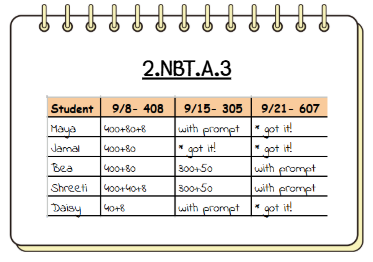
An anecdotal log fixes this by asking for almost nothing. A date. A student's name. Symbols, a few words, sometimes a sentence, tied to the look-for you were already watching for. That's it. The goal isn't a complete picture of the student. It's a breadcrumb that is specific enough that it means something when you read it back in three weeks.
There are two simple ways to organize this, and either works:
- A log by student. One running record per child, with a few lines added over time. Good if you want to see a single student's trajectory at a glance.
- A log by look-for. One record per skill or marker, with student names added as you see it. Good if you're watching a whole group for the same thing and want to see who's showing it and who isn't, side by side.
Neither needs to be fancy. You may use a notebook page, a shared spreadsheet, or an index card taped inside a lesson plan book. The format matters far less than whether you'll actually use it. Pick whichever one fits how you already think, and resist the urge to build something elaborate before you've tried the simple version.
What you're building, one short entry at a time, is a record you can actually use; this matters, because noticing and documenting only pay off once they change what you do next.
Respond, And Notice Again
A log entry that just sits there isn't documentation. It's a diary. The whole point of noticing and writing something down is what happens after. This is the step that's easy to skip, because it's the one that asks you to do something later, not just today.
This is also where Constance Hallemeier’s blog, “Shifting the Mindset: Demystifying Data,” and this one meet. That earlier shift, from reteaching to responsive intervention, from grading to learning, isn't a mindset you adopt once. It's a decision you make over and over, in small moments, using whatever you actually know about a student right now. Your log is what makes "right now" specific instead of a guess.
Say your look-for was whether a student could explain their thinking out loud, not just get the right answer. Your log shows three entries over two weeks: close… close… then finally there. That's not a data point to file away. That's the moment you decide: this student is ready for something harder, or that group needs one more day with the scaffold before you pull it. The log didn't just record the moment. It told you what to do with it.

Going back to Ms. Davis and Maya, the next afternoon during planning, Ms. Davis and I chatted. She took less than twenty seconds to review her log. Looking back at Maya's row, she noticed three dated entries across two weeks: 9/8: 408 as "400+80+8" (misconception on zero placeholder); 9/15: needed card prompt for 305; 9/21: independently explained zero placeholder in 408. Without that brief log, Maya’s quiet breakthrough might have blurred into the general chaos of the math block, and Ms. Davis might have kept her in the foundational place-value small group for another week out of habit. Instead, seeing the progression documented in black and white gave her the clarity to make an immediate instructional move: she transitioned Maya to independent problem-solving with three-digit number comparisons and shifted her small-group focus to students who are still wrestling with place-value zeroes.
This continuous cycle keeps our small groups fluid and responsive, preventing students from being stuck in the same placement week after week. Each instructional response naturally generates fresh observations to track—evaluating whether a challenging assignment took root or an additional day of scaffolding successfully bridged the gap. Rather than a linear process completed once, noticing, documenting, and responding forms an ongoing professional habit that seamlessly integrates into daily teaching practice.
A Head Start on the Look-For Work
This framework starts before you even walk into the room—with a clear learning progression and specific look-fors to guide your observations. Teams often build these progressions collaboratively during PLC time, breaking down a standard together to agree on what student understanding looks like at each step. While this process deepens shared clarity, developing progressions standard by standard takes significant time and coordination.
For schools looking for a starting point or a way to streamline that process, pre-built resources like the Comprehensive Standards Guides (CSGs) from Compass PD can offer a helpful foundation. Each CSG outlines a standard's learning progression and proficiency scale, providing teams with ready-to-use look-fors they can adapt to their needs.
Whether teams design their own progressions or start with pre-built guides, the value lies in the shared understanding they create. As Dr. Kallie Dace, a middle school ELA teacher in Spring Bluff R-XV, noted: "The CSGs can help us have important, meaningful collaborations around the standards and our own curriculum, instruction, and assessment." Having clear look-fors in place — however you establish them — allows teachers to focus their energy where it matters most: on noticing, documenting, and responding to student learning in real time.
Starting Small, On Purpose
If you're reading this as a coach or a building leader, the instinct is understandable: pick a template, roll it out to the whole staff, ask for it by Friday.
I ask you to please resist that instinct. A framework this simple can survive a clumsy start, but it won't survive being handed down as one more mandate with a due date attached.
Start with one piece. One look-for, pulled from a progression your team already uses. One log format, chosen because it's the easiest one to actually keep up with, not the most thorough. Model it yourself in a PLC. Bring your own log entries, read one out loud, show what you noticed and what you did about it. Let teachers see the loop working before you ask them to run it themselves.
From there, it grows the way anything sustainable grows: one teacher tries it, talks about it, and a second teacher borrows the idea because they know it has worked. That's slower than a rollout. It's also the version that's still happening in April.
And if you're an ambitious teacher reading this without a coach pushing it, you don't need permission to start. Pick a group, pick a look-for, keep a log for two weeks, and see what you notice about your own noticing.
This cycle holds up well in a single classroom, where one teacher can watch one roster closely. It gets more interesting, and more necessary, once you're not looking at one class, but six sections and a hundred and fifty students, and "noticing" starts to mean something closer to catching a discourse pattern across a hallway than watching one small group. That's where the next piece in this series picks up: observational data, and what documentation looks like in a secondary classroom.
References:
Black, P., & Wiliam, D. (1998). Inside the black box: Raising standards through classroom assessment. Phi Delta Kappan, 80(2), 139–148.
Heritage, M. (2021). Formative assessment: Making it happen in the classroom (2nd ed.). Corwin.
van Es, E. A., & Sherin, M. G. (2002). Learning to notice: Scaffolding new teachers' interpretations of classroom interactions. Journal of Technology and Teacher Education, 10(4), 571–596.