By Dr. Sherri Lorton
I’ve had the opportunity to sit with grade-level teams as they unpack standards together. It’s always interesting to see the conversations evolve. What begins as a discussion about a single standard quickly becomes a discussion about student thinking, prerequisite skills, and what evidence teachers would want to see along the way. In my experience, the process is very emotional. The majority of educators get frustrated at first - feeling like the work is a waste of time (their words, not mine). There is frustration about wordsmithing and structure, often including lengthy discussions about one specific word, phrasing, or even punctuation within the standard. But once you get past the initial reaction, it gets better. They will start talking about what students need to know and be able to do - if we dig deep about student understanding. This only happens when someone facilitates the process (or if a team member is a standard nerd!).
In previous articles, I've explored why balanced instruction matters and why standards—not instructional resources—should drive curriculum decisions. The next question is a practical one:
How do teachers translate standards into meaningful daily instruction?
One powerful answer is through learning progressions.
All of those instructional decisions that teachers need to make become easier—and more intentional—when they have a clear understanding of where learning is headed and how students develop the knowledge and skills needed to get there.
Learning progressions provide that roadmap.
Rather than viewing standards as isolated learning goals or daily lessons as disconnected activities, learning progressions organize the student evidence we should see as learners build toward proficiency. They make the pathway to mastery visible to teachers and students by identifying the explicit learning targets from the standard, the implicit understandings uncovered through unpacking, and the evidence students should demonstrate as they develop greater understanding over time.
Simply put, learning progressions help us see where students are on their learning journey with a standard and what they need to learn to continue toward mastery.
When teachers across a grade level, department, or district work from shared learning progressions, they create more than consistency. They create instructional coherence. Students experience connected learning from classroom to classroom and from one grade level to the next, while educators develop a shared understanding of the learning they are working together to support.
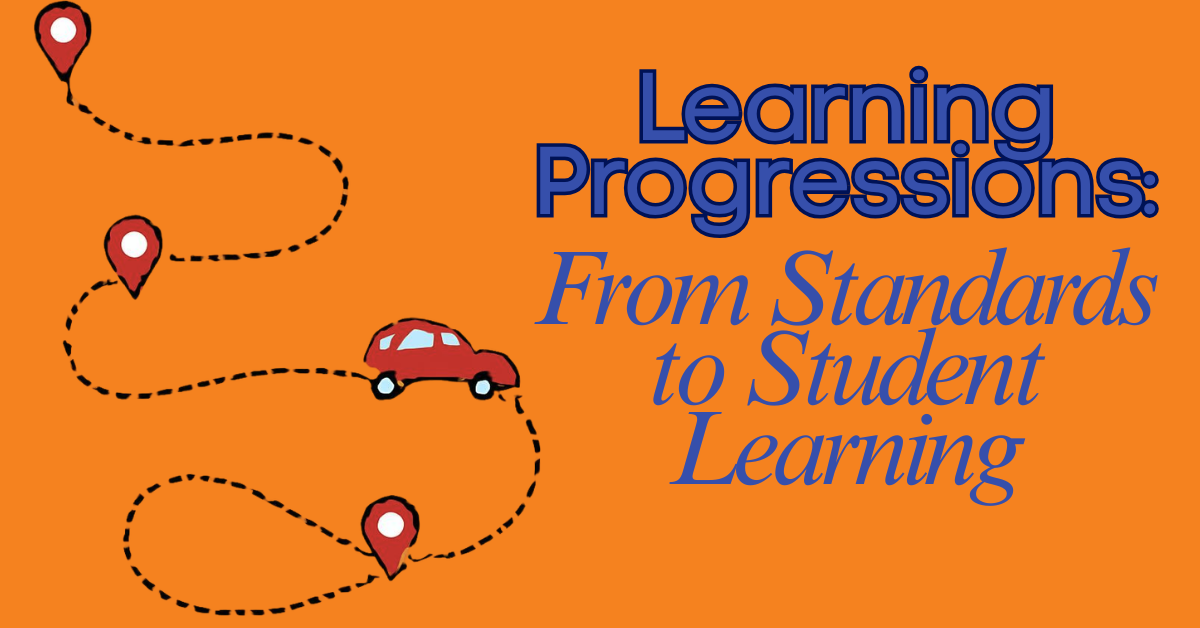
Hop in, and let’s go for a ride as I take you through our team's journey of creating learning progressions. My hope is that you will see their relevancy to each standard and how they can empower both teachers and students alike. Buckle up!
Standards Are the Foundation
Learning progressions begin with the standards.
State and local standards define what students should know and be able to do, establishing clear expectations for learning. They describe the destination, but they do not prescribe every instructional decision teachers should make along the way.
That distinction is important.
As we explored in “A Resource Isn't a Curriculum- You’ve Been Told a Tale,” instructional resources are valuable tools, and they support—but do not always determine—instruction. Likewise, standards identify the desired outcomes, but they do not automatically reveal the sequence of learning that will help students reach those outcomes.
Teachers are expected to make those decisions every day.
The most effective instructional planning begins by asking a simple question:
What does this standard really require students to know, understand, and do?
Answering that question is the first step in developing meaningful learning progressions.
Unpacking the Standard

Before educators can decide how students will learn, they must first understand the learning embedded within the standard itself.
This process—often called unpacking or unwrapping a standard—goes beyond identifying a skill or selecting an activity. It is the professional work of analyzing the standard to determine exactly what students need to learn before instruction begins.
As we unpack a standard, several questions help guide the process:
- What knowledge and skills are explicitly stated in the standard?
- What concepts are essential for students to understand?
- What academic vocabulary will students need to use accurately?
- What does proficiency look like?
- What evidence will demonstrate that students have met the expectations of the standard?
These questions shift instructional planning away from "What lesson should I teach?" and toward "What learning do my students need?"
That shift is subtle, but changes everything.
Instead of organizing instruction around pages in a textbook or activities in a digital platform, teachers begin organizing instruction around student learning.
Looking Beyond What the Standard Says
One of the most valuable outcomes of unpacking a standard is recognizing that successful learning often requires more than what is explicitly written.
Every standard contains explicit knowledge and skills—the learning students are expected to demonstrate. But effective instruction also requires teachers to identify the implicit learning that supports those expectations.
Implicit learning includes the prerequisite concepts, foundational understandings, reasoning processes, and background knowledge students need in order to become successful.
An elementary mathematics standard may ask students to apply the formulas for area and perimeter. While the standard explicitly identifies the expected performance, students may also need to understand the definition of each of these terms, recognize that opposite sides of a rectangle are equivalent, interpret visual models, and explain their mathematical thinking before they can consistently demonstrate proficiency.
Likewise, a secondary English language arts standard asking students to analyze how a character changes throughout a text assumes students can identify textual evidence, understand cause-and-effect relationships, distinguish between description and analysis, and communicate their thinking effectively.
These understandings may not be written directly into the standard, but they are often essential to helping students achieve it. Making this implicit learning visible allows teachers to intentionally plan instruction rather than hoping students develop these understandings on their own.
Learning Progressions Turn Standards Into Actionable Learning
Standards state the destination for students. Of course, students rarely move from initial exposure to mastery in a single step. They develop understanding gradually, building new knowledge on prior learning, strengthening reasoning, and making connections that are not always stated directly within the standard itself.
Learning progressions take the explicit learning identified in the standard, combine it with the implicit understandings uncovered during unpacking, and organize that learning into a logical sequence that supports growth over time.
Instead of serving as an assessment tool, learning progressions become an instructional tool. They help teachers determine what learning comes next, provide meaningful feedback, support student goal setting and self-assessment, and make instructional decisions that move students toward proficiency.
Understanding a standard is an essential first step, but standards alone do not always make the path to mastery clear. Learning progressions help by showing the evidence teachers should look for on a student’s journey to build understanding over time. They connect the explicit learning targets in the standard with the implicit knowledge and concepts uncovered through unpacking.
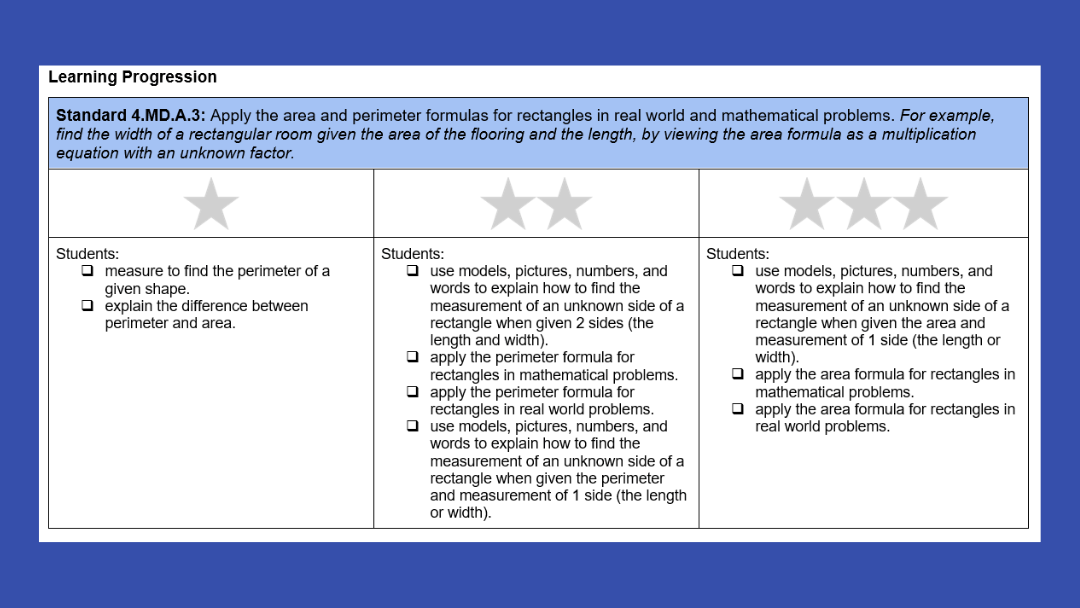
Rather than asking students to leap from introduction to mastery, learning progressions break learning into meaningful steps. For example, in a mathematics standard focused on applying the area and perimeter formulas, students first build an understanding of what each term is, then learn how to use models and words to explain each. Over time, they can apply the formulas in real world problems.
The purpose is not to move students through a checklist of skills, but to help teachers recognize where students are in their learning, identify what evidence to look for next, and support deeper understanding.
Because learning progressions are built around student evidence, they become valuable tools for helping students understand and take ownership of their learning.
They provide students with a clearer understanding of:
- What am I learning?
- Where am I in my learning?
- What can I do next to continue growing?
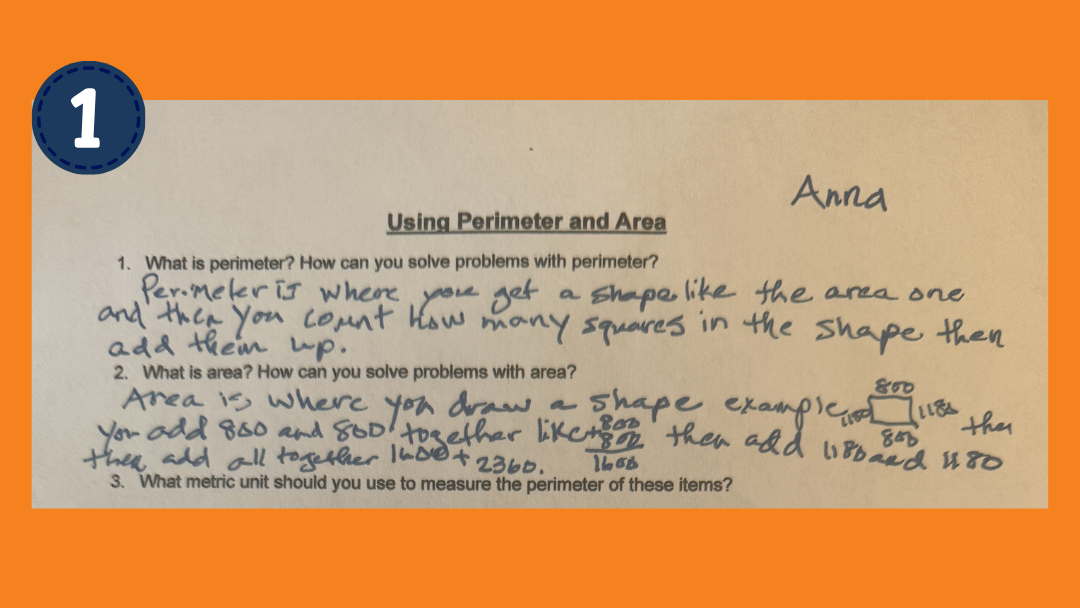
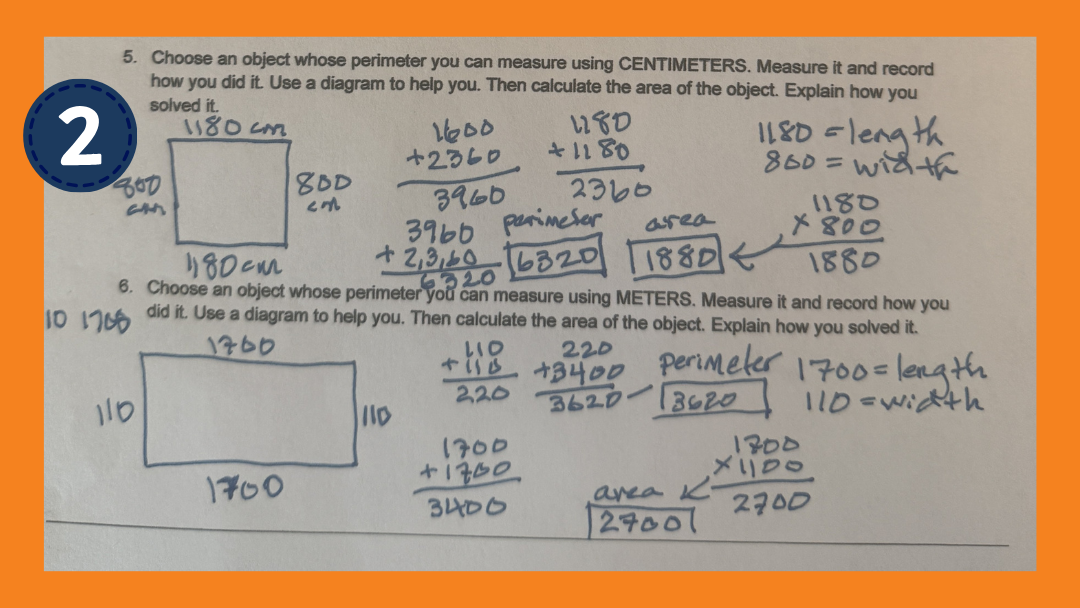
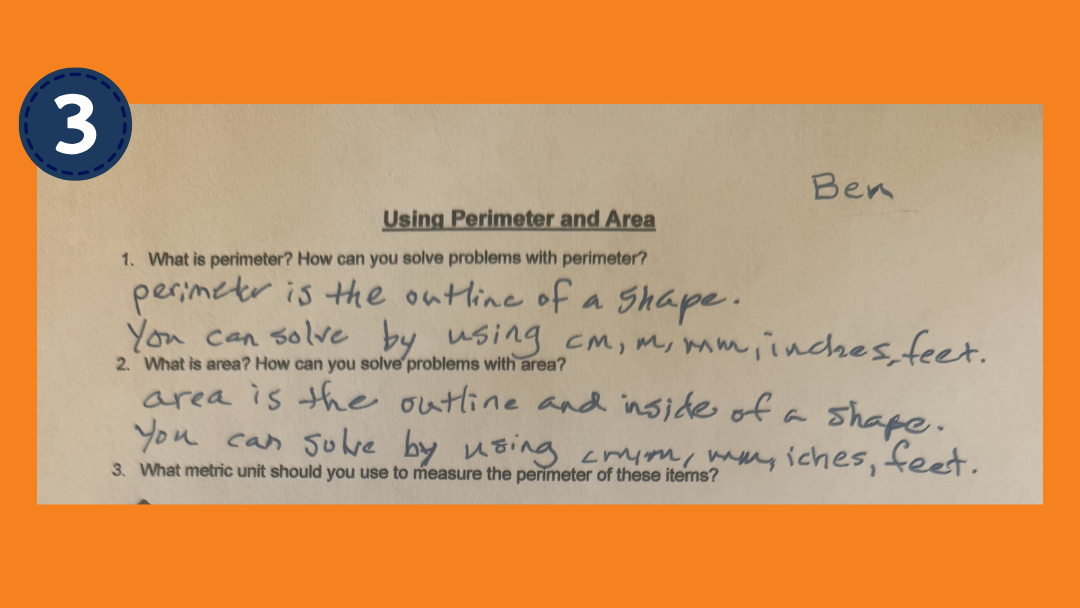
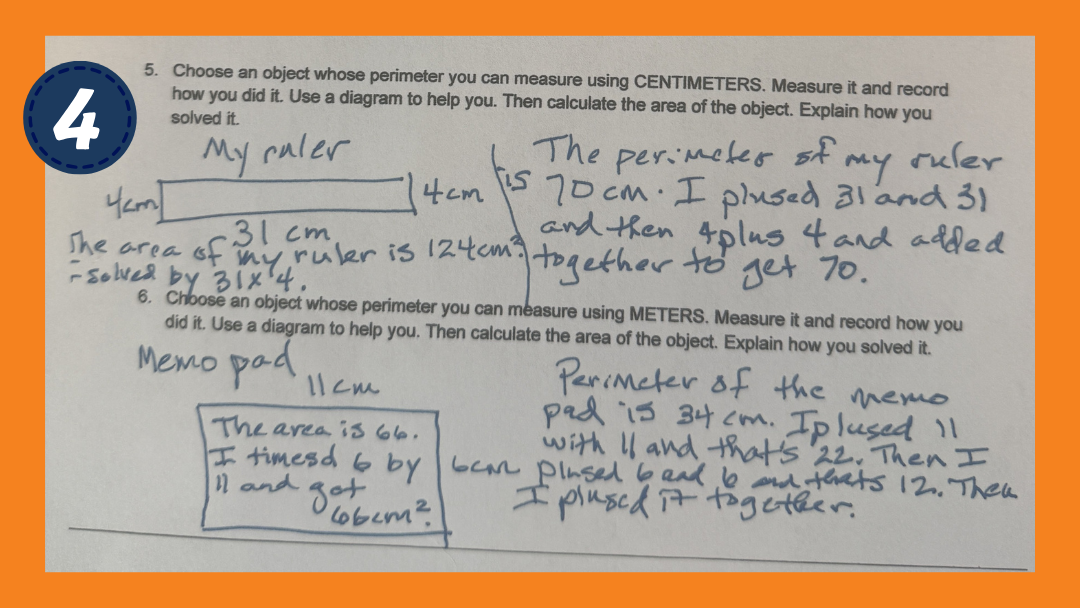
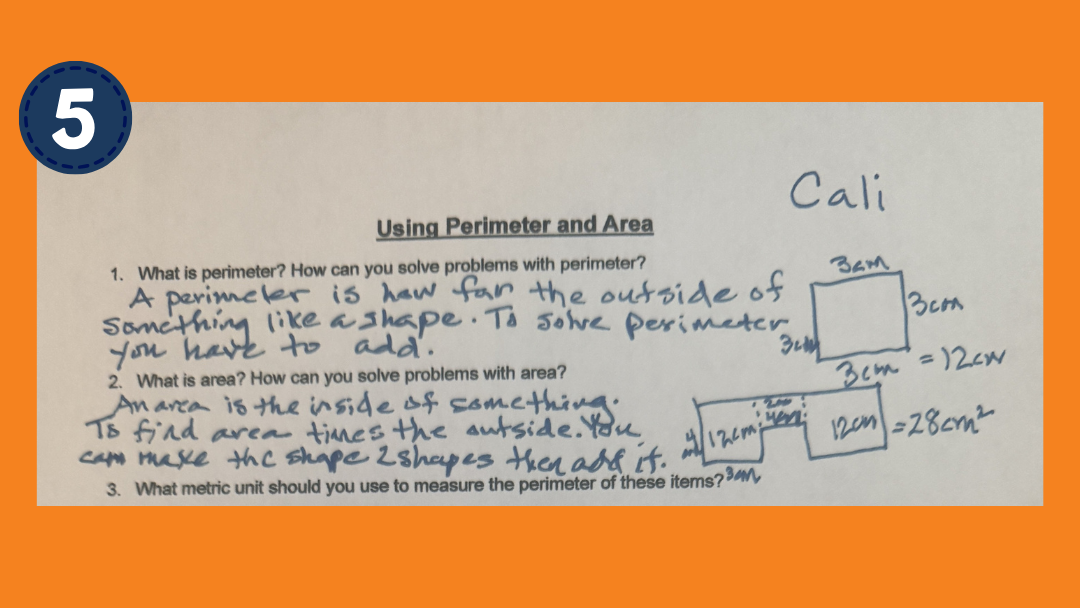
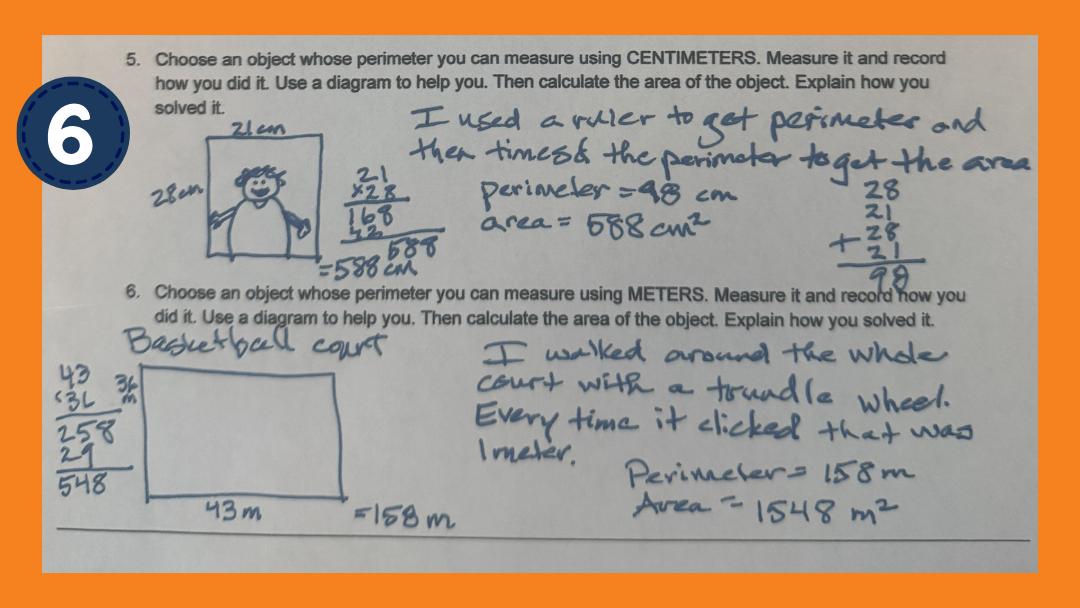
When using the learning progression for the standard 4.MD.A.3 shown above with the pictures of a given assessment below, you can see students at different levels of understanding. Below, in the first two pictures, Anna still needs to work on skills and knowledge in the far left column with one star. She is still struggling to distinguish between perimeter and area, and is not able to effectively use the formulas for each. In the third picture, Ben is able to explain the difference between perimeter and area, but is not clearly explaining how to solve problems using each. However, in the fourth picture, you can see that he understands how to find perimeter, but having difficulty finding the area- he is still working on the skills from the middle column with two stars. Cali is at/near mastery, and is in the right column with three stars. She shows understanding and application of the formulas for both perimeter and area, and uses pictures and words to explain her knowledge.
When students can see the steps involved in developing understanding, learning becomes more manageable and meaningful. Students can reflect on their progress, set goals, participate in conversations about their learning, and better understand the feedback they receive. It is incredibly powerful and satisfying to hear a student tell you, the teacher, where they are on their learning path and know exactly what they need to ask for next.
For teachers, learning progressions provide a common language for those conversations. Instead of simply telling students they need more practice, teachers can identify the highest level of learning students can already demonstrate, celebrate that progress, discuss where they are in the progression, and identify the next step that will move them closer to proficiency. Students gain a clearer understanding of what they have accomplished, what comes next, and how they can continue moving forward.
This shifts feedback from being a judgment of performance to being guidance for continued growth.
Learning Progressions Strengthen Classroom Instruction
One of the greatest benefits of learning progressions is that they help teachers make more intentional instructional decisions. Without a clear progression, teachers may know the end goal but struggle to identify what students need before they can reach it. Learning progressions help reveal the sequence of understanding that supports successful learning.
In a secondary English language arts class, a standard may ask students to analyze a theme in a text and support their thinking with evidence. A teacher using a learning progression understands that students first need opportunities to identify important details, determine what those details reveal about characters or events, recognize patterns across a text, and explain how evidence supports an interpretation.
The progression does not tell the teacher which book to use, what questions to ask, or how to structure the lesson. Those decisions remain part of the teacher's professional expertise.
Instead, the progression clarifies the learning students need to demonstrate. This distinction matters.
Because learning progressions make learning visible, they also make intervention more meaningful. Instead of simply recognizing that a student has not yet mastered a standard, teachers can identify the specific step where support is needed. This allows Tier 2 instruction to focus on the next learning students need rather than repeating instruction they have already mastered.
Learning progressions are not scripts. They are not pacing guides. They do not replace teacher judgment or creativity. They provide a shared understanding of the learning students are developing, so teachers can make stronger decisions about how to support them.
Shared Learning Progressions Create Coherence Across Teams and Grade Levels

I’ve seen planning conversations change when teams begin using shared learning progressions.
Instead of asking, “Where are you in the book?”, teachers begin asking, “What are your students doing to show they are able to do this?” That simple shift changed the conversation from pacing to learning.
This creates more meaningful collaboration because teachers are discussing learning, not simply coverage.
Learning progressions also strengthen vertical alignment across grade levels.
During a curriculum planning session, a fourth-grade teacher remarked, “I always assumed students learned this in third grade.”
The third-grade teachers smiled and replied, “We thought they learned it in second!”
The room laughed, but it highlighted an important reality. Without shared understanding of how standards progress, it’s easy to make assumptions about what students already know.
Shared learning progressions make those connections visible. They help teachers understand what students have already learned, what they are ready to learn next, and how learning develops over time. Shared learning progressions also promote consistency in Tier 2 instruction by helping educators across classrooms and support settings focus on the same learning goals and student evidence.
For students, this creates a more connected experience. Learning feels less like a series of separate expectations and more like a continuous journey.
Building Sustainable Systems for Student Learning
One of the things I’ve come to appreciate while working with schools is that teachers rarely struggle because they lack expertise or commitment. More often, they are making hundreds of important instructional decisions without a shared picture of how learning develops.
Learning progressions don’t replace that expertise—they support it. They give educators a common language for understanding student learning while allowing for the professional judgment that great teaching requires.
Resources such as Compass PD's Comprehensive Standards Guides can support teams by providing standards that have been unpacked into clear learning targets, proficiency expectations, and learning progressions while allowing educators to maintain ownership of instructional decisions.
When teachers know what students are expected to learn, understand what proficiency looks like, and can see the steps students take along the way, instruction becomes more intentional. Students benefit from clearer goals, more meaningful feedback, and stronger connections across their learning experiences.
Ultimately, learning progressions help answer one of the most important questions educators ask: How do we help every student move from where they are today toward where they need to be?
By making the pathway visible, learning progressions provide educators and students with a clearer way forward.
References:
Ainsworth, L. (2015). Unwrapping the standards: A simple process to make standards manageable (2nd ed.). Advanced Learning Press.
Hattie, J. (2009). Visible learning: A synthesis of over 800 meta-analyses relating to achievement. Routledge.
Learning Forward. (2022). The standards for professional learning. Learning Forward.
National Research Council. (2001). Adding it up: Helping children learn mathematics. National Academies Press. https://doi.org/10.17226/9822
Wiggins, G., & McTighe, J. (2005). Understanding by design (Expanded 2nd ed.). Association for Supervision and Curriculum Development.
About the Author