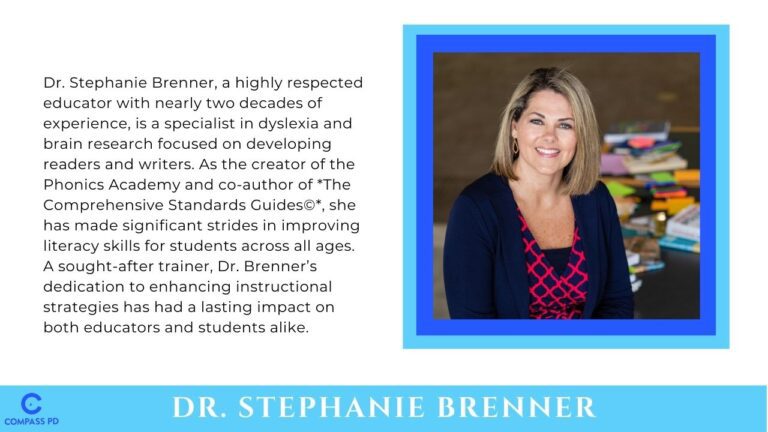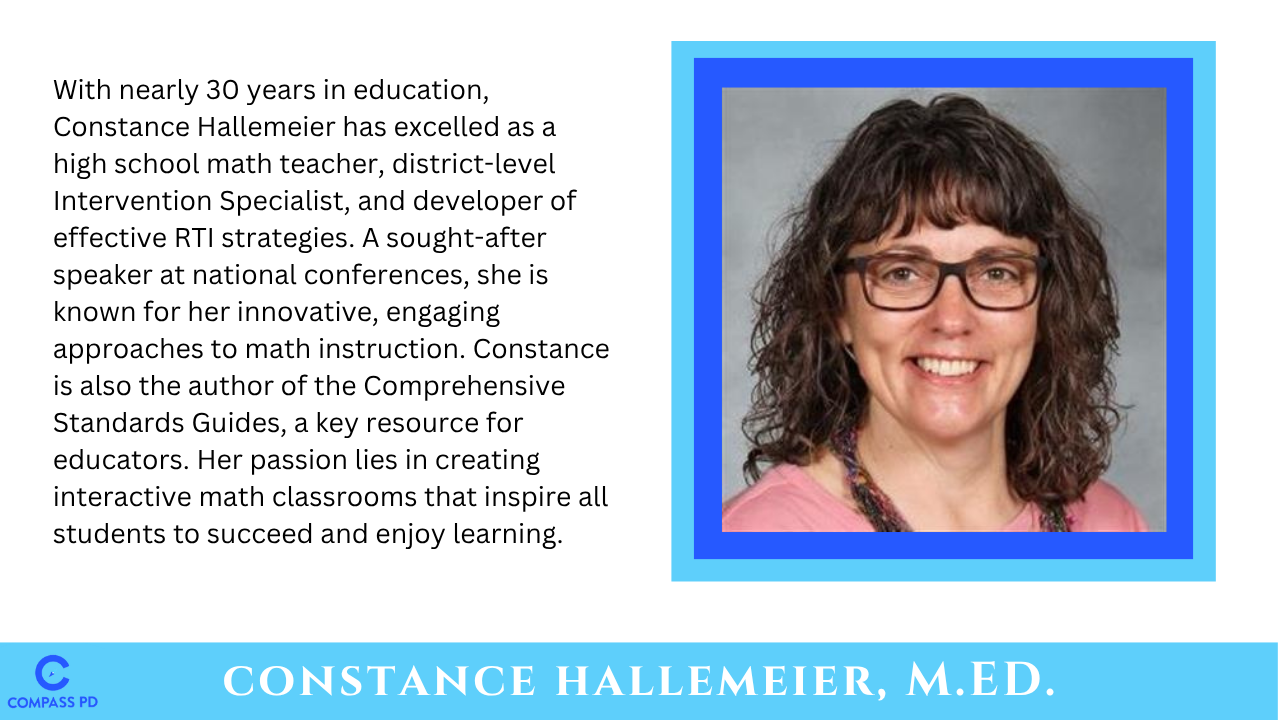
By Dr. Stephanie Brenner and Constance Hallemeier, M.Ed.
In the world of K-12 education, proficiency in the state standards is the destination, but it rarely comes with a map. Telling a teacher to "ensure students can analyze how complex characters develop over the course of a text" is like handing someone a compass and telling them to build a house. To bridge the gap between high-level mandates and daily classroom reality, districts seeking greater instructional coherence are turning to Comprehensive Standards Guides© (CSGs) developed by Compass PD.
But what exactly are they, what do they contain, and how can your district leverage them alongside leading educational frameworks? Let's break it down.
What are the Comprehensive Standards Guides©?
The Comprehensive Standards Guides© are much more than an unpacking of academic standards. They are an instructional planning resource designed to help educators understand not only what students are expected to learn, but also how learning develops, what teachers should prioritize, and how instruction can be designed to help every student reach proficiency. Rather than treating standards as isolated expectations, the CSGs place every standard within a larger learning progression and provide educators with practical tools for implementation. The result is a resource that serves classroom teachers, instructional coaches, interventionists, curriculum directors, and administrators alike.
Instead of leaving interpretation of the standards up to individual teachers, which can lead to vast inequities from classroom to classroom. The Guides establish shared expectations for rigor and proficiency while allowing teachers to make responsive instructional decisions based on student needs. Think of them as the ultimate DNA strands for a district's curriculum.
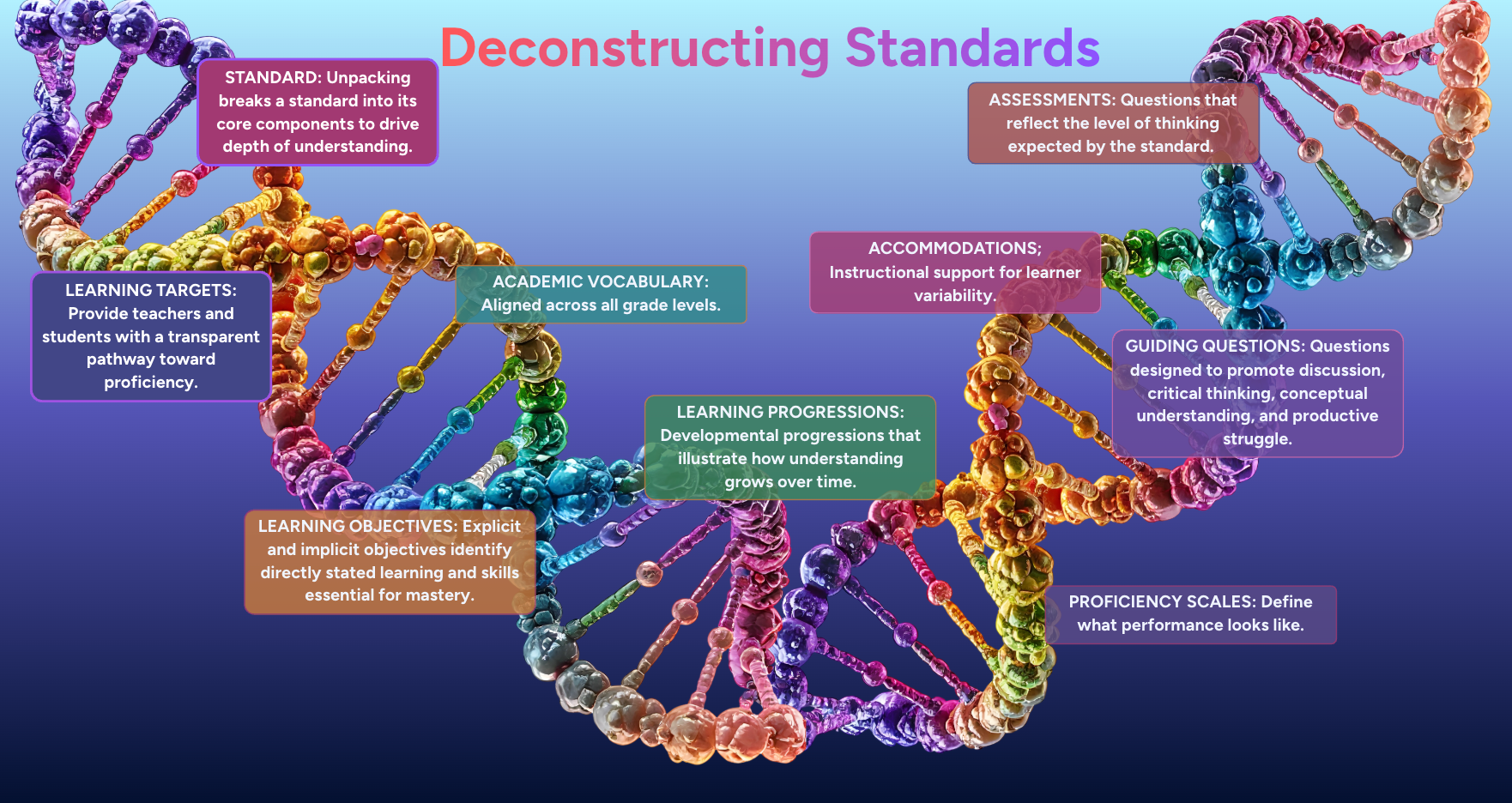
The Anatomy of a Comprehensive Standards Guide©
The Comprehensive Standards Guides© provide educators with a complete, centralized picture of a standard and its surrounding instructional decisions. Instead of forcing teachers to search through multiple documents, websites, and professional books, the CSGs serve as a single, organized resource.
Going far beyond a simple copy-and-paste job of state objectives, the CSGs deeply analyze and "unpack" standards to remove ambiguity, highlight required rigor, and support more equitable access to grade-level learning.
Unpacked Standards and Learning Targets
Each standard is carefully analyzed to identify:
- the knowledge students must acquire,
- the skills they must demonstrate,
- the level of cognitive demand,
- the context in which learning occurs,
- the progression from foundational understanding to mastery.
From this analysis, clear learning targets are developed and sequenced from less complex to more sophisticated learning, providing teachers and students with a transparent pathway toward proficiency.
Academic Vocabulary
Success depends on understanding the language of the discipline.
Each CSG identifies and defines the academic vocabulary students must know to successfully meet the standard. Because vocabulary is intentionally aligned across grade levels, districts create greater consistency while reducing unnecessary cognitive load for students as they progress through the curriculum.
Explicit and Implicit Learning Objectives
One of the greatest strengths of the Comprehensive Standards Guides© is distinguishing between what the standard explicitly requires and what students must already know to achieve success. Explicit objectives identify the learning directly stated in the standard. Implicit objectives identify the prerequisite knowledge and foundational skills that often remain hidden but are essential for mastery. Making both visible helps teachers anticipate learning gaps before they become barriers.
Learning Progressions and Proficiency Scales
Learning rarely happens all at once. The CSGs organize learning into developmental progressions that illustrate how understanding grows over time. Accompanying proficiency scales clearly define what performance looks like from beginning understanding to advanced application. These progressions help teachers plan instruction, provide meaningful feedback, monitor growth, and communicate expectations clearly with students and families.
Accommodations, Scaffolds, and Extensions
High-quality instruction begins by planning for learner variability, not reacting to it later. Each CSG includes instructional support for multilingual learners, students needing additional scaffolds, and opportunities to extend learning for students ready for greater challenge. Rather than treating differentiation as an add-on, the CSGs embed equitable instructional planning directly into the curriculum.
Guiding Teaching Questions
Powerful instruction begins with powerful questions. Each standard includes guiding questions designed to promote discussion, critical thinking, conceptual understanding, and productive struggle. These questions help teachers facilitate deeper learning rather than simply checking for correct answers.
Aligned Summative Assessment Questions
Assessments should reflect the level of thinking expected by the standard. The CSGs include examples of assessment questions and sample performance tasks that align directly with the rigor of the learning targets, ensuring that what teachers assess truly matches what students were expected to learn.
How Are They Different from Traditional Standards Unpacking?
Many standards documents stop after identifying the verbs, nouns, or cognitive demand of a standard. While those exercises help teachers interpret expectations, they rarely answer the instructional questions teachers ask every day:
- What skills should students already have before I teach this?
- Where does this learning lead in later grades?
- What misconceptions should I anticipate?
- What does mastery actually look like?
- How do I know students are ready to move on?
- What instructional strategies are most effective for teaching this concept?
The Comprehensive Standards Guides© answer those questions. Rather than simply analyzing standards, they connect standards to classroom practice. Instead of asking teachers to make those instructional decisions independently, the CSGs provide research-informed guidance that helps create consistency across classrooms, grade levels, and schools.
How Districts Can Leverage the Guides
Districts use the Comprehensive Standards Guides© in a variety of ways because they support both instructional improvement and systems-level planning.
|
Curriculum Development |
The CSGs provide a foundation for building or refining curriculum by ensuring learning experiences align directly to grade-level expectations. |
|
Professional Learning |
Instructional coaches and professional learning teams use the CSGs to deepen teachers' understanding of standards while building common instructional language across schools. |
|
PLC Conversations |
Rather than spending valuable PLC time interpreting standards, teams can focus on planning instruction, analyzing student work, and responding to assessment data. |
|
Assessment Design |
Because the CSGs clearly identify what proficiency looks like, teachers can create formative and summative assessments that truly measure intended learning. |
|
Intervention and Acceleration |
Understanding prerequisite skills and learning progressions allows intervention teams to identify where students need additional support and target instruction more precisely. |
|
New Teacher Support |
For teachers who are new to a grade level or content area, the CSGs reduce the steep learning curve by providing context, instructional guidance, and practical support all in one place. |
The True Value of the Comprehensive Standards Guides©
The Comprehensive Standards Guides© transform standards from broad expectations into clear, actionable guidance for instruction. By creating a shared understanding of what to teach, how learning progresses, and what mastery looks like, they strengthen instructional consistency, collaboration, and student success.
Improving Instructional Coherence and Consistency
Students experience greater consistency from classroom to classroom and year to year when every teacher operates from a shared understanding of learning expectations, prerequisite skills, instructional priorities, and evidence of mastery. This alignment strengthens curriculum implementation by directly connecting high-level institutional goals to daily classroom reality. Furthermore, it elevates collaboration by transforming conversations in teacher teams, shifting the focus away from merely interpreting what a standard means and toward actively designing strategies to improve student learning.
Moving Beyond Compliance to High-Quality Instruction
Standards were never intended to be a mere checklist; while they define what students should know and be able to do, the quality of instruction ultimately determines whether they reach those goals. To move beyond basic compliance toward high-quality instruction, The Comprehensive Standards Guides (CSGs) bridge the gap between expectation and implementation. By transforming standards from isolated compliance statements into practical, everyday tools, the CSGs empower educators to plan, teach, assess, and support student learning more effectively in the classroom.
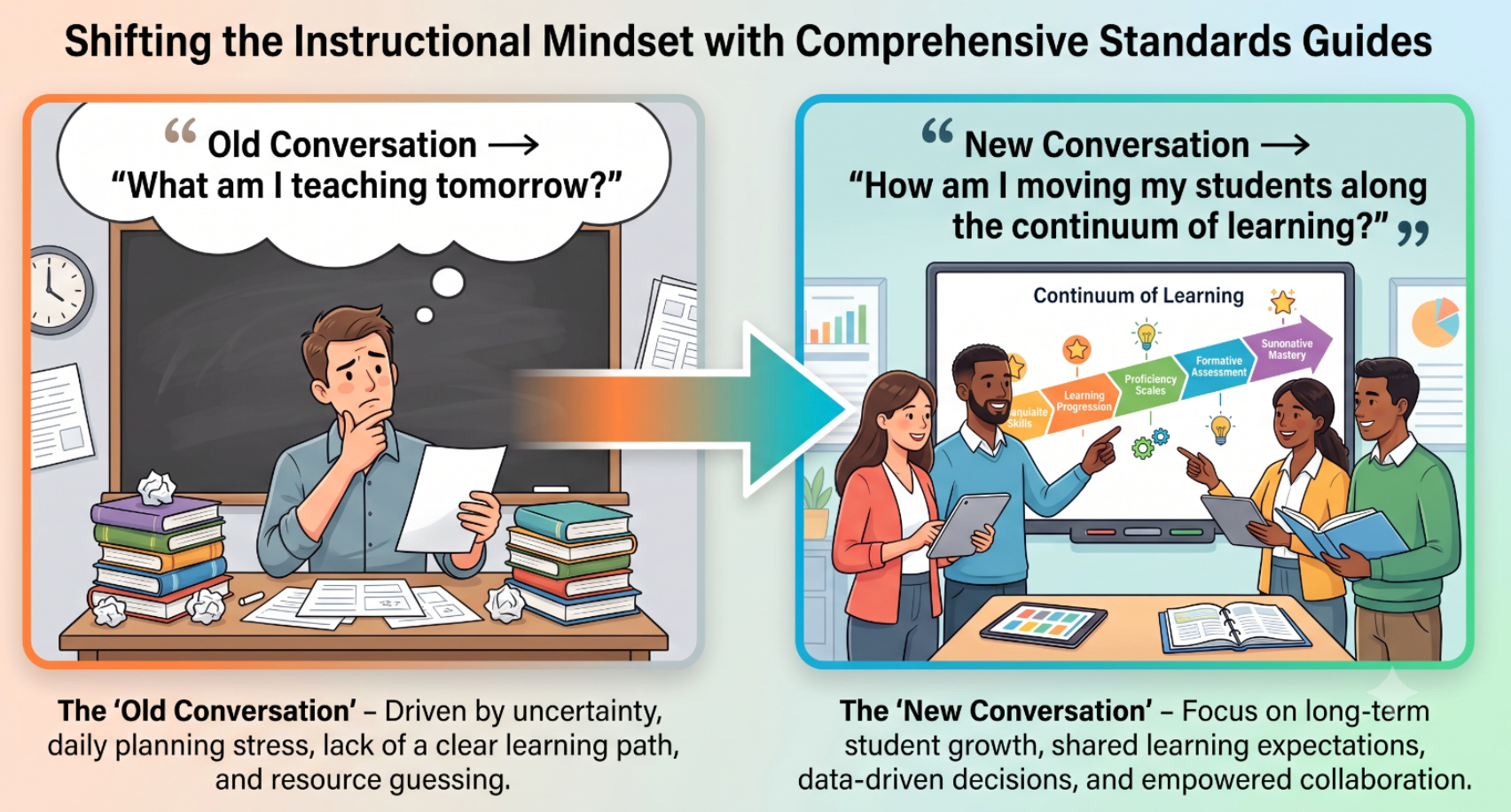
Shifting the Instructional Mindset
By investing the time to unpack standards, define vocabulary, map progressions, and weave in research-backed frameworks (such as Marzano, NCTE, and NCTM), the CSGs strengthen daily planning, instruction, and assessment.
The Bottom Line
When educators have greater clarity about both the destination and the instructional path to get there, they can spend less time deciphering standards and more time helping students succeed. That is the true purpose of the Comprehensive Standards Guides©, and this is why districts are using the Guides to strengthen curriculum, instruction, assessment, and professional learning.
If you are interested in additional information about the Comprehensive Standards Guides©, please reach out to Compass PD.
References
Leinwand, S., Brahier, D. J., Huinker, D., Berry, R. Q., Dillon, F. L., Larson, M. R., Leiva, M. A., Martin, W. G., & Smith, M. S. (2014). Principles to Actions: Ensuring Mathematical Success for All. National Council of Teachers of Mathematics.
Marzano, R. J. (2017). The New Art and Science of Teaching. Solution Tree Press.
National Council of Teachers of English. (1996). Standards for the English Language Arts. International Reading Association and the National Council of Teachers of English.
About the Authors