By Dr. Natalie Fallert
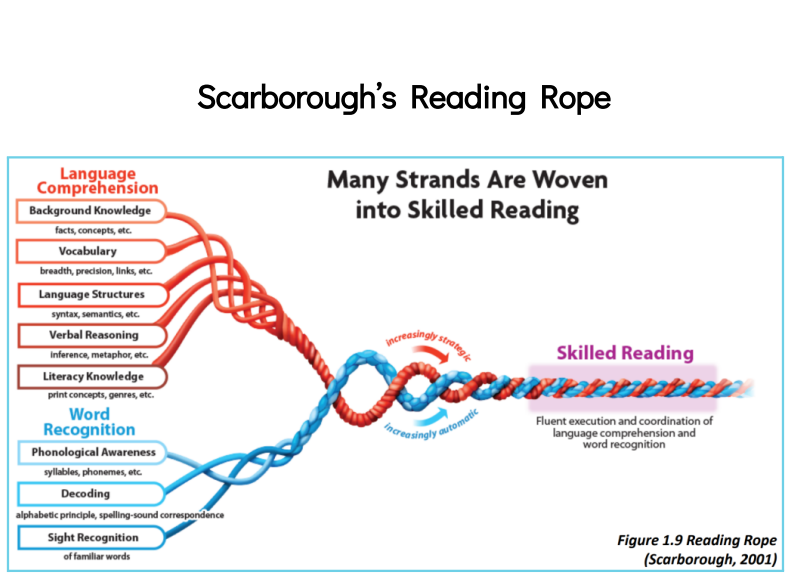
Welcome back to my fifth (and final) installment on the Science of Reading from a secondary lens. Here, I will finish with two aspects of the language comprehension strand of Scarborough's Reading Rope: Print Awareness/Concepts and Comprehension.
Before we go any further, a reminder: the Science of Reading is grounded in decades of research about how the brain works—how it learns, processes, and applies knowledge. As you read, keep asking yourself how this strand fits into the brain’s workload during reading.
Print Awareness Didn’t Stay in Elementary School
When most educators hear the phrase print awareness, they picture kindergarten classrooms, alphabet books, and students learning how books work. Secondary teachers rarely think of print awareness as part of their job description. After all, our students already know how to read a book, follow text left to right, and recognize punctuation.
But the more I dig into the Science of Reading and spend time in classrooms across the country, the more convinced I become that print awareness never actually disappears—it simply becomes more sophisticated.
At the secondary level, we often assume students understand how texts work because they can physically decode the words on the page. However, many students struggle not because they cannot read the words, but because they do not fully understand the increasingly complex structures, conventions, and patterns embedded within the text itself.
And when students struggle to navigate a text's structure, comprehension suffers.
Print Awareness Evolves as Students Grow
In the earliest grades, print awareness focuses on foundational concepts such as book handling, text direction, punctuation, spacing, and understanding that words carry meaning. These are the visible building blocks of literacy.
As students move through elementary school, print awareness expands to include understanding of headings, paragraphs, captions, diagrams, glossaries, indexes, and organizational structures across genres. Students also begin navigating digital literacy skills such as hyperlinks, menus, and search results.
By middle and high school, print awareness shifts again. Students are expected to understand argument structures, evaluate credibility, analyze evidence, interpret multiple plot lines, navigate discipline-specific texts, and conduct research across various content areas.
The problem is that somewhere along the way, we stop explicitly teaching many of these skills and begin assuming students will simply figure them out on their own.
The Secondary Mistake: Assuming Students “Just Know”
One thing I have noticed in middle and high school classrooms is that many students appear to struggle with the texts and literacy demands commonly associated with upper elementary grades. The more I reflect on this, the more I wonder whether part of the issue lies in our lack of explicit instruction beyond elementary school.
As secondary teachers, many of us unintentionally assume students already understand how increasingly sophisticated texts work. I know I did.
I assumed my students understood genre conventions, text structures, and organizational patterns because I understood them. What I failed to recognize was that those structures become more complex as texts become more complex.
If we never explicitly point out those changes, students can quickly fall behind.
For example, when teaching To Kill a Mockingbird, I would discuss Boo Radley’s story and Tom Robinson’s story, but I rarely explicitly taught students that the novel contains multiple intersecting plot lines. I would discuss Scout’s growth and changing views on gender roles, but I did not deliberately map how those ideas developed across the text.
I assumed students naturally saw those connections because I saw them.
Many of our struggling readers do not.
Genre Knowledge Supports Comprehension
This becomes especially important when we teach genres like fantasy and dystopian fiction.
Do we explicitly teach students the predictable structures and conventions found within those genres? Do we explain that fantasy texts often include invented words, unfamiliar settings, and complex world-building? Do we prepare students for the fact that dystopian novels frequently function as social commentary?
If we do not, students may spend so much mental energy trying to decode the structure of the text that they have little cognitive capacity left for deeper comprehension.
For example, when students encounter a word like Quidditch in Harry Potter, some readers become stuck trying to determine whether the word is real, whether they should already know it, or whether they missed something important. Explicitly telling students that fantasy texts often include invented language immediately reduces confusion and cognitive load.
The same is true for dystopian literature. Students benefit when we explicitly explain that these stories often involve broken societies, conflicting ideologies, oppressive systems, and characters who challenge the rules of their world. Once students recognize those patterns, they are better equipped to make inferences and engage in critical thinking.
In many ways, genre instruction is comprehension instruction.
This is not just an English Language Arts issue.
Every content area contains unique text structures, organizational patterns, and disciplinary expectations. AP textbooks are structured differently from traditional textbooks. Scientific research articles look different from historical analyses. A welder’s handbook requires different reading skills than a Shakespearean sonnet.
I often do an activity with teachers in which I hand them a text from a discipline outside their expertise. It is fascinating to watch math and science teachers wrestle with a complex poem while English teachers attempt to navigate technical manuals or scientific texts.
Even highly educated adults struggle when they are unfamiliar with the structure and conventions of a text type.
Why would we assume students would not struggle as well?
The reality is that every discipline approaches literacy differently, and students need explicit instruction within those disciplinary structures.
Research Is Also a Form of Print Awareness
Research provides another strong example of this idea.
Too often, research skills are treated as the responsibility of the English department alone. However, every subject area approaches research differently.
A historian evaluates primary sources differently than a scientist evaluates experimental data. An argumentative essay in English may prioritize current sources and contemporary relevance, while a history classroom may require older documents because historical context matters more than publication date.
Students need explicit instruction in how information is organized, presented, and valued within each discipline.
Without that guidance, comprehension and analysis become significantly more difficult.
What Explicit Instruction Can Look Like
In the summer of 2025, my twin boys had to read 1984 for a summer assignment. There were no class discussions throughout the summer—students simply needed to read the novel and answer questions independently.
Before we started reading, I wanted to provide some support without giving anything away. I explained that dystopian novels typically involve a society where something has gone wrong. I told them to pay attention to the rules of the society, identify who benefits from those rules, and notice which characters challenge them. We also discussed how dystopian literature often serves as social commentary connected to real-world issues.
As we read, our conversations became significantly richer because they had a framework for understanding the text. They were able to make predictions, develop theories, and make inferences because they recognized the predictable patterns embedded within the genre.
That support did not lower the rigor of the text.
It increased access to it.
Comprehension Is the Product of Many Reading Strands Working Together
As secondary educators, we often treat comprehension as an isolated skill. We expect students to infer, analyze, synthesize, and evaluate simply because they have reached middle or high school.
But comprehension does not exist independently.
When we examine Scarborough’s Reading Rope, we see that comprehension is the product of many interconnected strands working together. Vocabulary knowledge, background knowledge, language structures, verbal reasoning, decoding skills, fluency, and print awareness all contribute to a student’s ability to understand a text.
When one or more strands are weak, comprehension becomes more difficult.
This realization completely changed how I think about student writing as well. One of my favorite questions to ask myself when discussing weak analytical writing is this:
Is this actually a writing problem, or is it a reading problem?
If students do not fully understand the vocabulary, structure, context, or organization of a text, it becomes incredibly difficult for them to write thoughtfully about it.
If We Want Students to Love Reading, We Must Help Them Access It
Many teachers say they simply want students to love reading. But if we honestly ask ourselves why some students dislike reading, the answer is often not motivation alone.
Many students dislike reading because reading is difficult for them.
They struggle to navigate complex texts, unfamiliar structures, discipline-specific language, and hidden organizational patterns. Offering students more “interesting” texts will not solve the problem if they still lack access to the text itself.
The Science of Reading reminds us that comprehension is not magic. It is the result of deliberate, interconnected skills developing over time.
As secondary educators, we do not need to become elementary teachers. However, we do need to recognize that explicit literacy instruction still matters long after students leave elementary school.
Print awareness did not disappear.
It simply grew up alongside our students.
References
- Iowa Department of Education. (2025, May). Iowa Comprehensive State Literacy Plan 2024-2032. Des Moines.