By Dr. Carrie Hepburn
In 2014, I was a classroom teacher immersed in the early days of the Science of Reading and participating in LETRS training with Dr. Louisa Moats and her team. Like so many educators, I was learning, studying, and changing my practice. Our district invested in professional learning because we believed that if teachers understood the research and applied it well, more students would become successful readers.
And for a while, that's exactly what happened.
Our knowledge grew. Instruction improved. We became more intentional about phonics, decoding, and intervention. We had better conversations about reading development and why some students struggled. Most importantly, we saw students respond. We were making progress and we could see it in our classrooms.
Then, in 2019, I moved into district leadership, and I found myself asking a question I never expected.
What happened?
The same district that invested so heavily in this work was already beginning to drift. New teachers joined the staff without the same background knowledge. Leadership roles changed. New priorities and initiatives emerged. We were still deeply committed to literacy, but some of the practices we had worked so hard to build were no longer consistent across classrooms.
At first, I wondered if we had done something wrong.
Now, after working alongside districts across multiple states, I don't think that's true at all. I think we experienced something that almost every district eventually experiences. We thought the hardest part would be learning the Science of Reading.
It wasn't.
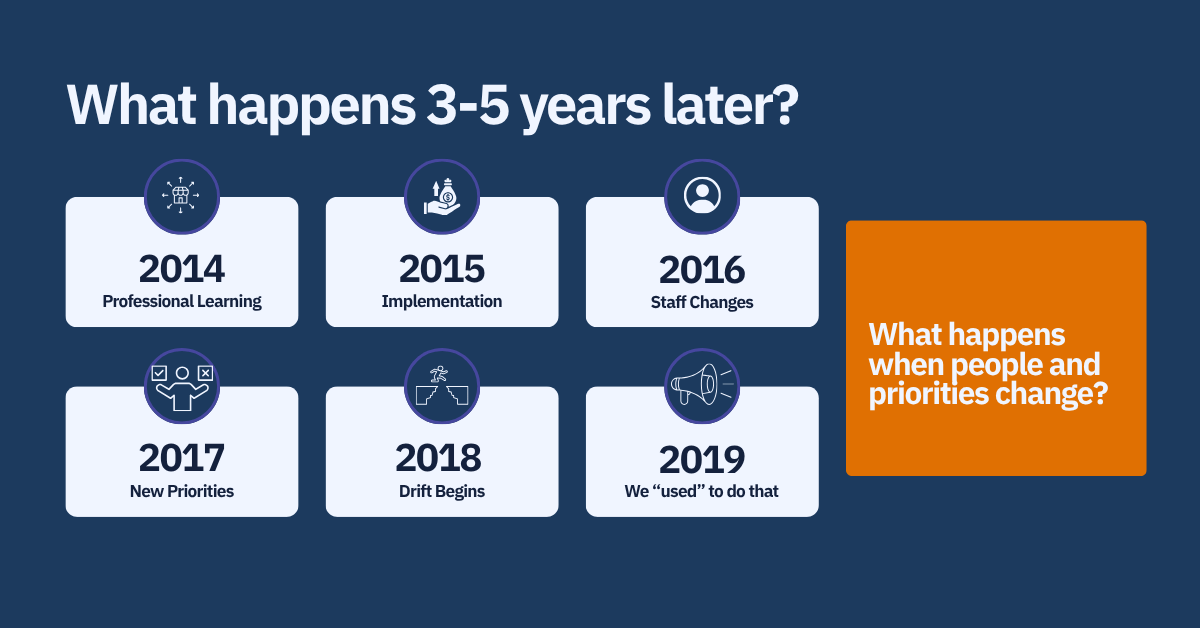
The hardest part was building systems strong enough to sustain it.
That is the part nobody talks about.
There are countless books, podcasts, and conference sessions dedicated to the Science of Reading, structured literacy, and high-quality instructional resources. There are fewer conversations about what happens three or four years later. What happens when staff changes? What happens when a district’s focus shifts? What happens when the next urgent initiative arrives? What happens when the people leading the work are not the same people who started it?
Those questions have shaped my thinking more than almost anything else.
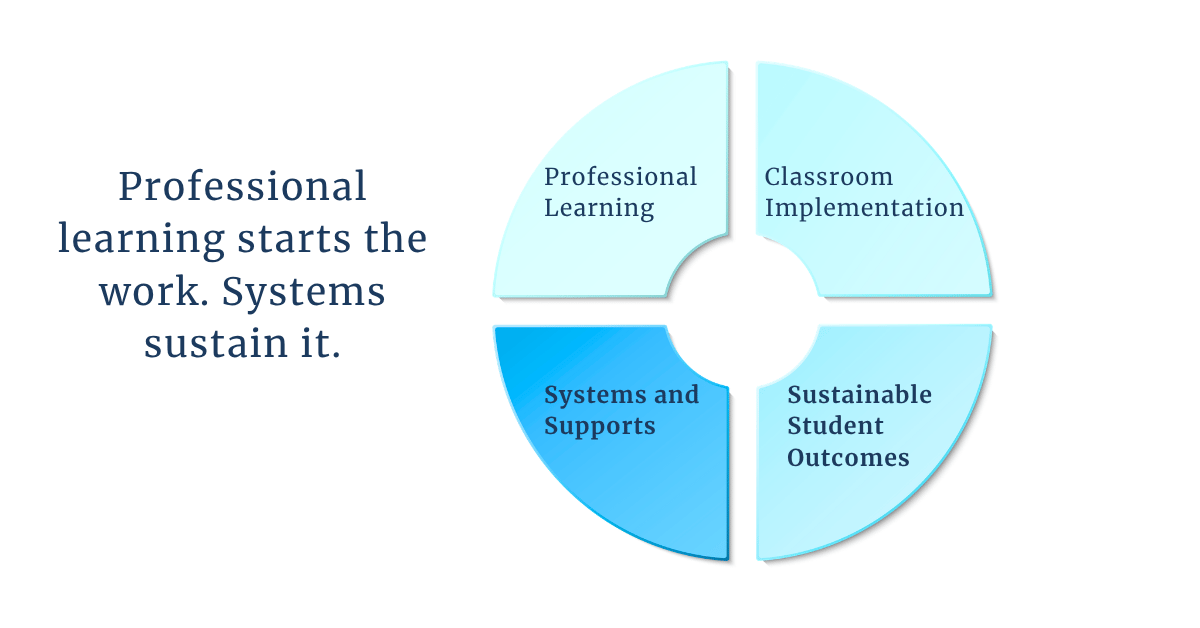
What I've learned is that the Science of Reading is not a one-time implementation effort. It is an ongoing commitment, and sustaining that commitment requires more than professional learning. It requires systems.
As I have reflected on this work and studied resources, state Comprehensive Literacy Plans, such as the Iowa Comprehensive Literacy Plan and the Second Order Change Model developed by Ambrose, Lippett, and Knoester, I've come to believe that sustaining literacy improvement depends on anticipating a handful of predictable challenges. While every district is unique, the patterns are remarkably similar.
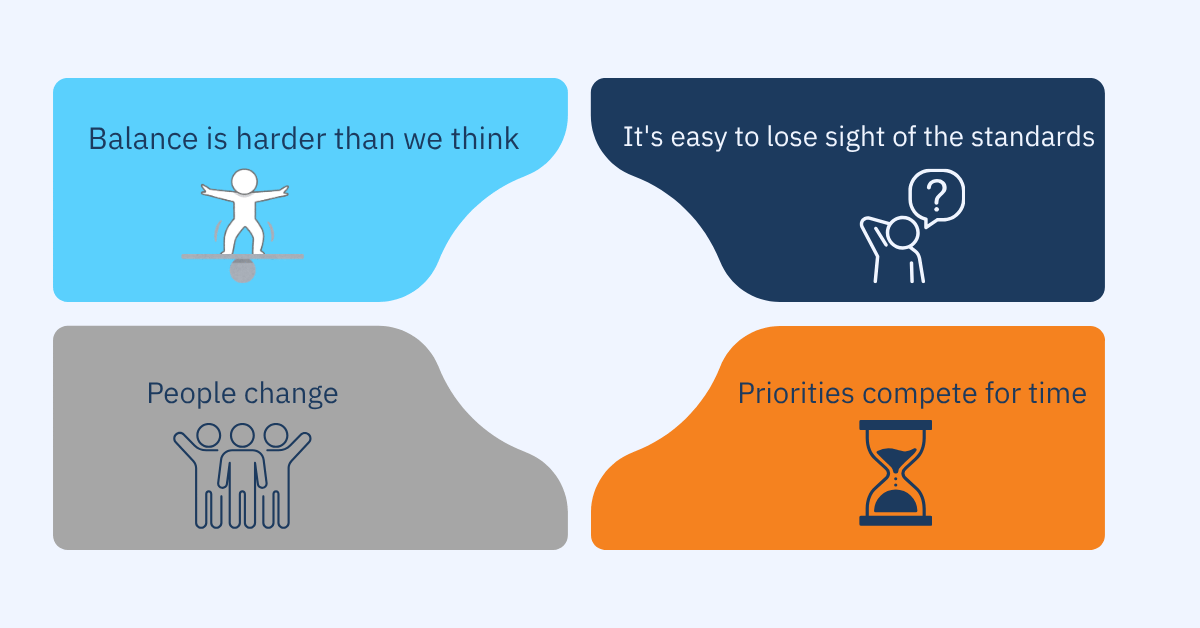
1. Balance is harder than we think.
When time is tight, and it always is, something quietly gives. In many districts, we become very good at protecting phonics instruction and intervention blocks. Those pieces mattered, and we should absolutely protect them. But without ever intentionally deciding to, we sometimes squeeze out knowledge-building, writing, rich discussion, and grade-level experiences. The challenge is never a lack of commitment. It is about finding balance across all components of effective literacy instruction.
Many State Comprehensive Literacy Plans remind us that comprehensive literacy is exactly that—comprehensive. Sustainable systems ensure that no single component overshadows the others.
2. It's easy to lose sight of the standards.
High-quality instructional resources are important, but they are tools, not the destination. Like many districts, we trusted that a strong resource would naturally cover everything students needed to know. We didn't always stop to ask whether the standards remained the true driver of instruction. The strongest districts I've worked with keep the standards as the anchor and use resources to support the work, not define it.
When standards become secondary to programs, implementation slowly shifts from intentional instruction to simply "getting through the materials." Sustainable systems continually reconnect teachers and leaders to the outcomes we want for students.
3. People change.
This one might be the most predictable challenge of all. We often do a beautiful job training the first group of teachers. Then people retire. New staff members join the district. Coaches change assignments. Principals move to new buildings. Before long, the people implementing the work are not the same people who experienced the original learning.
That's not a failure. It's simply the reality of education. But it does mean districts cannot assume that professional learning is a one-and-done event. The knowledge has to live somewhere beyond the individuals who first received it.
This idea aligns closely with second-order change. Lasting change is not dependent on a few champions; it becomes embedded in the culture and systems of the organization so that the work continues even as people come and go.
4. Priorities compete for time.
No district leader wakes up in the morning hoping to pull attention away from literacy. But schools are complex organizations. Mathematics, MTSS, assessment systems, social-emotional learning, curriculum adoption cycles, legislative requirements, and community engagement all deserve time and attention. The next urgent thing always arrives, and it is usually important.
The districts that sustain literacy growth are not the ones that avoid these competing priorities. They are the ones who build systems strong enough to keep the work moving forward anyway.
That has probably been the biggest lesson I've learned in my more than two decades in education.
Professional learning is essential. It builds knowledge, develops expertise, and creates momentum. I would never suggest otherwise. The investments districts have made in learning the Science of Reading have shifted educators' thinking, built knowledge, and, more importantly, improved student outcomes.
But professional learning alone does not sustain implementation.
Systems do.
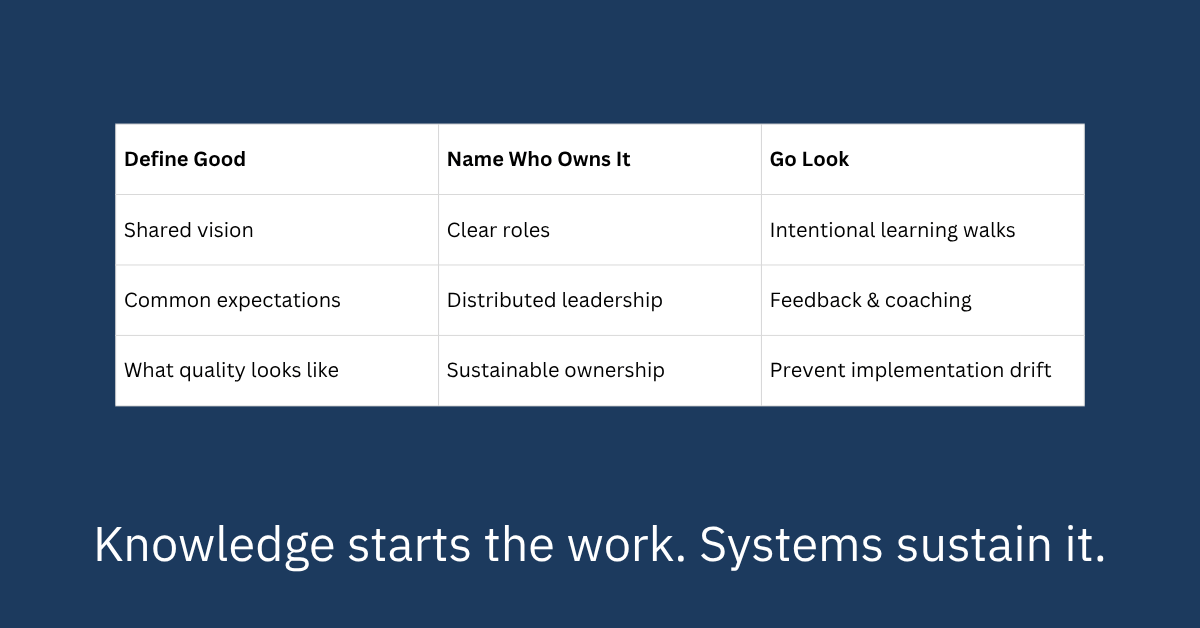
As I've worked alongside districts over time, I've noticed that the ones making lasting gains are not necessarily doing more. Instead, they tend to focus on three simple practices. Interestingly, these practices closely mirror the core ideas found in second-order change theory while adding one element that I believe is often missing from the conversation.
Define good.
Create a shared understanding of what high-quality literacy instruction looks like in your district. If no one has clearly defined "good," every classroom ends up creating its own version. A common vision gives teachers, coaches, and leaders something to work toward together.
Name who owns it.
Sustaining literacy improvement cannot rest on a single district leader, principal, coach, or enthusiastic teacher. Everyone has a role to play, and those roles should be clear. When ownership is shared, the work survives personnel changes and leadership transitions.
Go look.
This is the piece I believe is often missing. Defining expectations and assigning ownership are necessary, but they are not enough. The most successful districts I work with get into classrooms regularly, and with purpose. Not to "catch" teachers doing something wrong, but to understand implementation, celebrate successes, provide coaching and feedback, and notice drift before it becomes a larger problem.
Learning walks and classroom observations become opportunities to support the work, not simply evaluate it. They create the accountability and coaching loop that helps systems stay healthy over time. Without intentionally going to see the work, leaders cannot know whether the vision they have defined is actually becoming reality in classrooms.
Looking back, I realize that by 2019 I wasn't asking whether the Science of Reading worked. I already knew it did. I was asking a different question: Why do good districts, full of talented and committed educators, slowly drift away from the very work they know matters most?
I think the answer is surprisingly simple.
Knowledge starts the work. Systems sustain it.
The Science of Reading has given us a stronger understanding of how children learn to read. That is an incredible gift to education. But the districts making the greatest long-term gains have discovered something equally important: the goal is not simply to launch the Science of Reading. The goal is to build a district where the work is still thriving five years later.
And perhaps the most important lesson of all is this: sustainable change does not happen by training people once. It happens because we build systems that define the work, distribute ownership, and continually return to classrooms to learn, support, and improve together.
References:
Ambrose, Anthony, Ronald Lippitt, and Carl Knoester. A Second-Order Change Model for Transforming Schools. International Center for Leadership in Education, 2008.
Iowa Department of Education. Iowa Comprehensive Literacy State Development Grant: Iowa Comprehensive Literacy Plan. Iowa Department of Education, 2020, educateiowa.gov.
Moats, Louisa C. Speech to Print: Language Essentials for Teachers. 3rd ed., Brookes Publishing, 2020.
About the Author