By Dr. Sherri Lorton
Think back to the most transformative conversations you’ve had about teaching lately. For many of us, especially those of us working in or with elementary schools, those discussions have been anchored in the "Science of Reading." We’ve spent time wrestling with what it truly means to connect research to reality—how to make sure the way we teach literacy aligns with the way children actually learn. It’s been a shift toward clarity and coherence- ensuring that what students experience in classrooms aligns with how learning actually happens.
Now, we’re finding ourselves asking: What if we brought that same spirit of reflection to mathematics?
We aren't suggesting that we just copy-paste reading frameworks into math class. Instead, we need to think about the bigger lesson we’ve learned together: students flourish when instruction is purposeful, well-rounded, and respects the diverse pathways through which they construct understanding.
We know the terrain is a bit different. While reading research has produced a stronger body of converging evidence about how reading develops, the research on how students learn math is still evolving in important ways. There is strong foundational work in mathematics education, but no single, "magic" pathway that everyone agrees on. That makes it even more important for educators to rely on what research does consistently tell us: mathematical proficiency doesn't come from just one method. It’s built when we weave together understandings, experiences, and skills—never in isolation.
What Reading Instruction Can Teach Us About Comprehensive Math Instruction
One of the most powerful ideas from literacy research is that reading development is not built through a single skill or instructional method. Students do not become strong readers through decoding alone, nor through comprehension practice alone. Instead, reading proficiency develops when students are supported in building phonemic awareness, phonics, fluency, vocabulary, and comprehension in connected and meaningful ways over time. Most elementary educators are familiar with Scarborough’s Roper, which shows how these many strands work together as students develop reading skills and proficiencies.
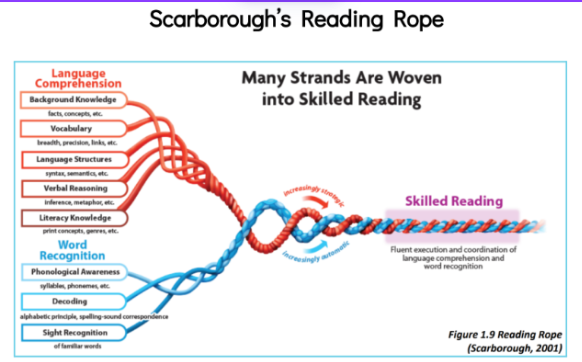
When instruction becomes too narrowly focused, only on isolated skills or only on meaning-making, students often struggle to transfer their learning. When instruction is more balanced, students are more likely to develop flexibility and independence as readers.
Mathematics works in much the same way. Students do not become mathematically proficient through memorizing procedures alone, nor through exploration without structure. They need opportunities to build understanding, develop efficient strategies, make sense of relationships, and apply reasoning in increasingly complex contexts.
Comprehensive instruction does not mean equal time for every activity every day. It means that over time, instruction is intentionally designed to develop the full range of mathematical thinking students need.
The Central Role of Number Sense and Conceptual Understanding
A strong foundation for mathematics instruction begins with number sense- the ability to understand numbers, relationships between numbers, and how quantities behave. Number sense is not a single skill; it is a developing awareness that supports all areas of mathematics, from computation to problem-solving.
When students have strong number sense, they are more likely to notice patterns, estimate reasonableness, and select efficient strategies. Without it, mathematics can become a set of disconnected procedures that must be memorized rather than understood.
Conceptual understanding works hand in hand with number sense. It refers to students’ ability to understand why mathematical ideas work, not just how to carry out steps. When students understand the structure behind procedures, they are better able to adapt their thinking to new situations.
An Elementary Example
Consider a student learning subtraction with regrouping. In a procedurally focused approach, the student may learn a set of steps: “borrow from the tens place,” “cross out,” and “add ten to the ones place.” The student may become accurate, but still struggle to explain why the steps work or recognize when to apply them.
In a more comprehensive approach, the same student might use base-ten blocks or drawings to physically regroup tens into ones. Over time, they begin to see that a ten is simply a collection of ten ones, and that regrouping is a way of renaming quantities rather than changing their value. The procedure is still learned, but it is anchored in meaning.
These examples are not about choosing one approach over another. They are about ensuring that procedures and understanding are developed together so that each strengthens the other.
Moving Beyond False Choices in Mathematics Instruction
Much of the current conversation in mathematics education becomes polarized around instructional “either/or” thinking:
- Explicit instruction versus inquiry-based learning
- Procedural fluency versus conceptual understanding
- Efficiency versus productive struggle
- Teacher guidance versus student exploration
In practice, these are not competing approaches. They are complementary elements of strong instruction.
Explicit instruction helps students access new ideas and build an accurate understanding. Inquiry and exploration help students make sense of patterns and relationships. Procedural fluency allows students to solve problems efficiently, while conceptual understanding ensures that those procedures are meaningful and adaptable. Productive struggle helps students develop persistence and reasoning, but it is most effective when it is supported—not left unsupported.
Strong mathematics instruction is not defined by choosing one side of these pairs. It is defined by knowing when and how to use each approach in the service of student understanding.
The Five Strands of Mathematical Proficiency
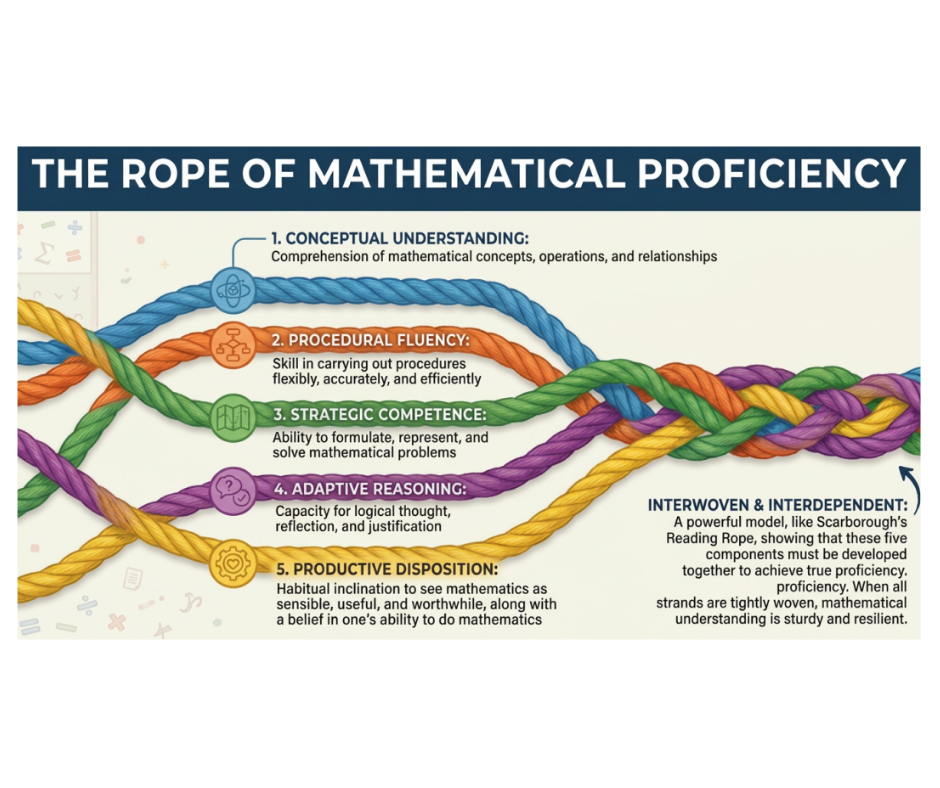
A helpful way to think about the many facets of mathematical proficiency comes from the National Research Council’s framework for mathematical proficiency. Rather than defining success in mathematics as speed or accuracy alone, this framework describes five interconnected strands:
- Conceptual understanding: comprehension of mathematical concepts, operations, and relationships
- Procedural fluency: skill in carrying out procedures flexibly, accurately, and efficiently
- Strategic competence: ability to formulate, represent, and solve mathematical problems
- Adaptive reasoning: capacity for logical thought, reflection, and justification
- Productive disposition: habitual inclination to see mathematics as sensible, useful, and worthwhile, along with a belief in one’s ability to do mathematics
These strands provide a more complete picture of what it means to be mathematically proficient. Importantly, they are not separate goals that can be checked off independently. They are interwoven dimensions of a single learning process.
How the Strands Work Together in Practice
In strong mathematics classrooms, the five strands are not isolated instructional targets. They show up together in meaningful learning experiences.
For example, in an elementary lesson on proportional relationships, students might begin by exploring a real-world situation, such as scaling up a recipe for Party Punch that requires 2 cups of apple juice for every 3 cups of soda. As they work to find how much soda is needed for 6 cups of juice, they develop a conceptual understanding of ratios and multiplicative relationships, recognizing that the ingredients must scale together to keep the flavor the same. Students build strategic competence as they decide how to organize this information, choosing to represent their thinking using a table or a double number line. They then demonstrate procedural fluency by accurately multiplying the quantities ($2 3 = $6 and $3 3 = $9) to solve the problem. Throughout the process, students exercise adaptive reasoning by logically explaining why doubling or tripling the ingredients works while simply adding cups ruins the recipe, ultimately fostering a productive disposition as they see math as a sensible, useful tool for real life.
As patterns emerge, students begin to generalize rules and develop procedural fluency in solving proportion problems. When asked to explain their reasoning, they engage in adaptive reasoning, justifying why their methods work and comparing strategies. Over time, as students experience success and see the relevance of the mathematics, their productive disposition strengthens—they begin to see mathematics as meaningful rather than arbitrary.
No single strand stands alone. Each supports and strengthens the others.
Instructional Coherence is Supported by How Standards Progress
While instructional decisions happen in classrooms, coherence is built at the system level. In math, similar to reading, clear standards help define what students should know and be able to do, but standards alone are not enough. Educators also need a shared understanding of how learning develops over time. Grade level teams should determine what is acceptable evidence for proficiency for each standard.
This is where learning progressions become especially important. When teachers understand how mathematical ideas build within and across grade levels, they are better able to design instruction that connects prior knowledge to new learning. Instead of seeing each lesson as an isolated event, instruction becomes part of a larger developmental story.
In coherent systems, standards and learning progressions support—not replace—professional judgment. They help educators make informed decisions about pacing, emphasis, and instructional design while maintaining focus on developing all strands of mathematical proficiency.
What This Looks Like Across Grade Levels
In the early grades, comprehensive instruction might look like students using manipulatives to explore addition and subtraction while also developing efficient mental strategies. Teachers support students in moving between concrete representations and abstract thinking.
In upper elementary grades, students might investigate fractions through visual models, number lines, and real-world contexts while also practicing computation strategies that build fluency over time.
Across all grades, the goal is the same: students develop deep understanding alongside flexible, efficient, and confident use of mathematics. Check out Constance Hallemeier’s in-depth examination of the intersection of the Science of Reading and secondary mathematics in her companion piece, Secondary Mathematics Instruction Meets Science of Reading.
Building Systems That Support Variety
Building understanding through comprehensive mathematics instruction is not just a matter of individual teacher practice. It requires coherent systems that support educators in making thoughtful instructional decisions.
-
For teachers, this means having access to high-quality tasks, clear learning goals, and time to understand how concepts develop.
-
For instructional coaches, it means supporting reflection on instruction—helping teachers see where instruction may be overemphasizing one strand at the expense of others.
-
For leaders, it means ensuring that curriculum, assessment, and professional learning are aligned toward a shared vision of mathematical proficiency.
When systems are aligned in this way, teachers are not asked to choose between competing priorities. Instead, they are supported in developing instruction that reflects the full complexity of mathematical learning.
A Final Reflection for Educators and Leaders
As mathematics education continues to evolve, one of the most important questions we can ask is not “Which instructional approach is best?” but rather:
- Are we developing all five strands of mathematical proficiency?
- Do students have opportunities to build both understanding and fluency?
- Are we supporting reasoning, strategy, and productive engagement with mathematics?
- Do our systems reflect how students actually learn mathematics over time?
Comprehensive instruction is not a compromise. It is a commitment to the full development of mathematical thinking.
When mathematics instruction is intentionally designed to develop understanding, skill, reasoning, strategy, and productive engagement together, students are more likely to experience mathematics as coherent, meaningful, and accessible. And when systems support that kind of instruction, the impact extends well beyond individual classrooms. Math instruction that models this commitment to student understanding is not just applicable to elementary classrooms. Check out Constance Hallemeier's look at the application to the secondary math classroom, Secondary Mathematics Instruction Meets Science of Reading.
References
Kilpatrick, J., Swafford, J., & Findell, B. (Eds.). (2001). Adding it up: Helping children learn mathematics. National Academy Press.
National Council of Teachers of Mathematics. (2000). Principles and standards for school mathematics. NCTM.
National Mathematics Advisory Panel. (2008). Foundations for success: The final report of the National Mathematics Advisory Panel. U.S. Department of Education.
National Research Council. (2001). Adding it up: Helping children learn mathematics. National Academy Press.
Shanahan, T. (2019). Reading research and reading instruction: Introducing the science of reading. American Educator.
Siegler, R. S. (2016). Magnitude knowledge: The common core of numerical development. Developmental Psychology, 52(4), 486–495.
Hattie, J. (2009). Visible learning: A synthesis of over 800 meta-analyses relating to achievement. Routledge.
About the Author